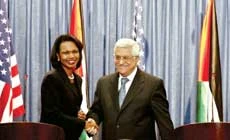
GAZA CITY, 5 October 2006 — Palestinian President Mahmoud Abbas and US Secretary of State Condoleezza Rice presented a united front yesterday, saying any Palestinian government should respect the peace principles set out by the world powers.
At the joint press conference with Rice in Ramallah, Abbas said: “Any unity government that will be established in the Palestinian Authority will be obligated to honor the signed agreements of the Palestinian Authority and to recognize the international and Arab decisions regarding it.”
“Today we say that any government to be formed has to be fully committed to all Palestinian, Arab and international legality and fully respect the agreements signed by the Palestinian Authority and the Palestine Liberation Organization,” he addedd.
He reiterated that stalled talks with Hamas on forming a unity government could not go on forever and warned that “the Palestinian leadership will decide on the measures to take to get us out of this crisis.”
After meeting Abbas on the third leg of a Middle East tour aimed at bolstering moderate Arab leaders and reviving the moribund peace process, Rice said the Palestinians should be served by a government “that observes the Quartet principles and that can form the basis then for movement forward on what we all desire.”
“And that is a two-state solution, a solution in which a democratic Palestine and a democratic Israel can live side by side in peace,” she told the joint news conference.
Rice said the United States is “very concerned” about the plight of the Palestinians and pledged to improve living conditions in the West Bank and Gaza Strip.
The so-called Quartet of major powers — the European Union, Russia, the United Nations and the United States — which has boycotted the Hamas government, sending the Palestinians into economic freefall, demands that any new cabinet recognize Israel, renounce violence and abide by past peace deals.
Hamas has so far refused immense pressure to soften its stance and Prime Minister Ismail Haniyeh accused Washington of being interested only in reshaping the region to fit its interests.
“The American administration only wants to reshape the region and the Palestinian territory in a way that only serves the American and the Israeli agenda,” he said.
Rice, who was due to meet Israeli Prime Minister Ehud Olmert for a private dinner later yesterday, heaped praise on the moderate Abbas.
“Because he is a leader that people respect, he is going to continue to have not just the attention of the international community but very intensive efforts to try to break through some of the deadlock that has been there and I think we will make progress,” she said.
She said they had also discussed ways to “facilitate” discussions between Israel and the Palestinians about issues that relate to economic development, such as Palestinian movement within their territory and ways to end violence.
The secretary of state arrived in Ramallah after brief talks with representatives of the “young guard” of the president’s moderate Fatah party and independent Palestinian MPs at the US Consulate in East Jerusalem.
Today, she is due to hold Jerusalem talks with her Israeli counterpart Tzipi Livni and Defense Minister Amir Peretz.
A senior Israeli security official said that Peretz will present the visiting secretary of state with options for reopening the crossings into the impoverished Gaza Strip.
Rice, who started her tour on Monday, said Washington was counting on a “new configuration” with its Arab allies to revive the peace process.
She said the group would involve the Gulf Cooperation Council — Bahrain, Kuwait, Oman, Qatar, Saudi Arabia and the United Arab Emirates — along with Egypt and Jordan, and would be called the GCC+2.
A number of papers in the Arab world predicted that the trip would end in failure unless Washington put real pressure on its Israeli ally.
“There is no point in pressing the Palestinians alone to come up with a government that meets the necessary international criteria for establishing peace in the Middle East. Equal pressure needs to be exerted on Israel,” the state-owned Jordan Times said in an editorial.
— With input from agencies