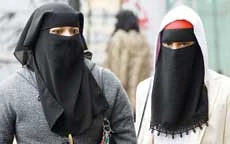
LONDON/JEDDAH, 7 October 2006 — Comments made by former British Foreign Secretary Jack Straw that it would be better if Muslims women didn’t cover their faces in a full veil has angered many Muslims.
Straw defended his comments yesterday that appeared in his regular column in Thursday’s edition of Lancashire Evening Telegraph, but he made it clear that those were his opinion and that he wasn’t advocating “prescriptive” measures in the UK.
Straw said he had asked Muslim women of his Blackburn constituency, which has a 30 percent Muslim population, to remove their face veils when they come to consult him. He said wearing of face-covering veils made community relations “more difficult” as they acted as “a visible statement of separation and difference.”
“I’m not talking about being prescriptive. But with all the caveats, yes I would rather (women did not wear full veils). Communities are bound together by informal chance relations between strangers. That is just made more difficult if people are wearing a veil,” he added.
Straw also made it clear that he was not referring to the hijab (hair covering), which is the predominant style among Muslim women. He also said he disagreed with the French government’s ban on the hijab in public schools — a ban that includes other religious expressions, such as the Jewish yarmulke and Christian iconography.
Reactions to Straw’s remarks in the Kingdom and the UK were mixed. The Muslim Public Affairs Committee said the comments were laughable, while the Islamic Human Rights Commission said Straw was selectively discriminating. However, the Muslim Council of Britain (MCB) said Straw’s views were understandable.
Islam Farooq, a Jordanian employee at a Jeddah-based multimedia company, said what Jack Straw said was not insulting to Muslims as a whole because the niqab constitutes an oft-disputed minority practice within the Muslim community. “The niqab (veil) is an unresolved controversial issue in the Muslim world itself,” he said.
Farooq said that in his country most women do not wear face-covering veils. He added that in a non-Muslim, secular country or multicultural country it becomes hard to practice the more extreme cultural or religious practices that cause conflicts with community relations.
“Muslims who live abroad are bound to face misunderstanding and sometimes racism,” Farooq said.
Respect Party leader George Galloway called for Straw’s resignation. Galloway, formerly a colleague of Straw in the ruling Labour Party before he was ousted over his vehement opposition to the Iraq war, said Straw was effectively asking women to “wear less.” “It is not women choosing to wear what they want that is sowing division in our society,” he added. “It is poverty, racism and the despicable competition between the Tory and New Labor frontbenches over who can grab the headlines as the hammer of the Muslims.”
Straw’s comments come only a week after Ruth Kelly, secretary of state for communities, launched her Social Cohesion Policy Unit, aimed at promoting greater integration and cooperation of British Muslims in the wider community. Conservative Party leader David Cameron at his party’s annual conference last week warned that many communities were growing up living “parallel lives” and only better contact would overcome differences.
Cameron pledged that a future conservative government would not allow Muslim ghettos to be formed where communities are isolated and cut off from the rest of society. He also pledged that Muslim faith-based schools would be forced to take in at least 25 percent of students from other faith groups, as is the general practice of Church of England and Roman Catholic schools.
The MCB, in many respects the creation of Straw when he was home secretary and then foreign secretary, said through spokesman Daud Abdullah: “This veil does cause some discomfort to non-Muslims. One can understand this.”
Even within the Muslim community the scholars have different views on this. There are those who believe it is obligatory for the Muslim woman to cover her face. Others say she is not obliged to cover up. It’s up to the woman to make the choice.
The Qur’an makes several references to women dressing modestly, but doesn’t state that women must cover their faces.
Allah says in the Qur’an: “And tell the believing women to lower their gaze and guard their private parts and not show off their adornment except only that which is apparent, and draw their veils over their (necks and) adornment except to their husbands, their fathers, their husbands’ fathers, their sons, their husbands’ sons, their brothers, or their brothers’ sons, or their sisters’ sons, or their women, or their slaves, or male servants who lack vigor, or small children who have no knowledge of women’s private parts. And let them not stamp their feet so as to reveal what they hide of their adornment. And turn you all to Allah in repentance, O believers, that you may be successful.” (Surat An-Noor 31).
Abu Dawood narrated that Aysha, wife of the Prophet (peace be upon him), specifically states that it is OK for women to show their faces and their hands: “O Asma, once a woman reaches the age of puberty no part of her body should be uncovered except her face and hands.”
“It is astonishing that someone as experienced and senior as Jack Straw does not realize that the job of an elected representative is to represent the interests of the constituency, not to selectively discriminate on the basis of religion,” said Islamic Human Rights Commission Chairman Massoud Shadjareh
But another Muslim human rights campaigner Ahlam Akram said Straw had “hit the nail on the head.”
“I stick to the argument that in this insecure world we are living today, I would rather prefer women coming to the UK, or even living in the UK, to respect the culture here as well,” said Akram.
“At the moment covering the face is a threat because I don’t know who is underneath that veil.”
Saleh Al-Ahmadi, a Saudi government employee, said that he’s not surprised to hear such a comment. “We hear a lot of things about Muslims especially from the West,” he said.
He noted that Straw is not a decision-maker and what he said was his personal opinion. “Instead of raging against comments, we should harness our energy in clarifying the image of Islam with peace and logic,” he said.