ISLAMABAD, 31 October 2006 — At least 80 alleged militants were killed yesterday by Pakistani troops using helicopter gunships in a pre-dawn attack on a madrasa located near the Afghan border, reported the Pakistan Army.
However, eyewitnesses say that the madrasa — located in the village of Chingai near Khar, the main town in the Bajaur tribal district in the North West Frontier Province (NWFP) — was full of religious students, who had just returned from their annual monthlong Ramadan holidays.
Missile-firing helicopter gunships hit the madrasa, which military spokesmen say was a training camp. In a press briefing held yesterday in Rawalpindi, Maj. Gen. Shaukat Sultan, director general of the Inter-Services Public Relations, said, “Some of the killed were foreigners but they do not belong to Al-Qaeda or the Taleban.”
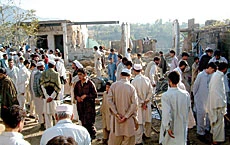
Local eyewitnesses say that “there were students in that madrasa” and not militants. At the site of the attack, dozens of villagers collected the remains of the dead from the rubble of the building, placing the mutilated body parts in large fertilizer bags.
Reporters at the scene said that children, some as young as seven, were pulled from the rubble. Thousands of people traveled from nearby villages to inspect the destroyed madrasa, some crying and others chanting, “Long live Islam.” The missiles leveled the building, tearing mattresses and scattering Islamic books, including copies of the Qur’an. Among the dead was the head of the madrasa, Maulana Liaquat Hussain.
The Muttaheda Majlis-e-Amal — which heads the regional government — not only condemned the attacks but is also staging protest rallies today. Haroon Rashid, a member of the National Assembly (NA), also forwarded his resignation for his NA seat. Likewise the chief minister of the NWFP Akram Durrani condemned the attack.
“The government has launched an attack during the night, which is against Islam and the traditions of the area…they (the victims) were not given any warning. This was an unprovoked attack on a madrasa. They were innocent people,” said Maulana Sirajul Haq, a Cabinet minister of the frontier government, while condemning the attack and also tendering his resignation in protest. He added, “The government killed many innocent people at the behest of foreign powers.”
In a routine weekly Foreign Office briefing held in Islamabad, spokeswoman Tasnim Aslam, refuted such claims. “No such direction was received by us from our friends particularly from the USA,” she said.
Gen. Sultan told journalists, “We had confirmed intelligence reports that 70 to 80 militants were hiding at the madrasa.” He added that the raid took place at a time when there were no prayers or religious activity taking place. The attack comes two days after the people of Bajaur staged a pro-Taleban rally in solidarity with the people of Afghanistan and coincides with peace talks between tribal elders and pro-Taleban militants in Bajaur.
Bajaur Agency, which borders Afghanistan’s insurgency-plagued eastern province of Kunhar, was the scene of the US Army’s controversial unmanned “Predator” strike in January. During that attack on the village of Dhamadhola, 13 people were killed leading to angry anti-US protests across Pakistan.
Yesterday’s killings sparked angry protests in Chingai, Khar and other Bajaur towns as local tribesmen and political leaders denounced the military, saying innocent civilians — not terrorists — had been killed.
According to sources there are thousands of madrasas across Pakistan providing orphans and poor children with free food, medicine, housing and Islamic education.
— With input from agencies