
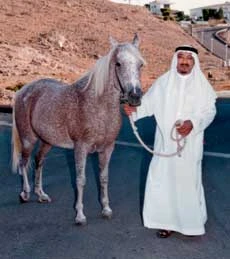
THE Arabian horse is a breed with a reputation for intelligence, high spirit, and outstanding stamina. It is one of the oldest breeds, with an ancestry dating to the ancient world.
Saudi Arabian horse enthusiasts have contributed greatly to the preservation of the pureblood of the Arabian horses with an untainted line of genealogy. These excellent breeds of horses with documented genealogy are found in thousands in the Kingdom now.
Mahmoud Fakhri is the first horse breeder to open the first modern stable — Al-Fakhriah Stable — in Jeddah over 50 years ago. His attempt has proved to be a successful experiment in the breeding and marketing of pureblooded Arabian horses.
Most Arabian horses have a compact body with a short back. Arabians usually possess dense, strong bone, sound feet, and good hoof walls. They are especially noted for endurance coupled with lithe bodies. Arabians have good natural balance, nimbleness and impulsion, qualities originally essential in a desert warhorse, and today seen in various competitive disciplines.
For centuries, Arabian horses lived in the desert in close association with humans.
As a young man, Fakhri was spurred by his fascination for the beauty and strength of the Arabian horse. His passion and attachment to them only increased as the years passed on. Then finally he started his own stable with a single pureblood horse. Today he owns about 70 horses with a stable sprawling over an area of 40,000 square meters in north Jeddah. The stable sits next to a modern running ground set to international specifications for training. His horses produce about 70 foals every year.
“While I started the stable there was no other stable in Jeddah,” he said. “The only other stable run by a man named Abdullah Suleiman Al-Hamdan — he and his brothers focused on breeding common riding horses in the Jamia district.”
In order to acquire more purebred horses Al-Fakhri had to go to international auctions and other related activities to buy mares and stallions for breeding.
Fakhri, who was the secretary general of the Jeddah Equestrian Club, said the King Abdul Aziz Center for Pure Arabian Horses at Wadi Dirab in Riyadh is the main center for officially registering pure Arabian horses, testing their blood and monitoring their breeding in the Kingdom. It represents the Kingdom at the World Arabian Horses Organization (WAHO).
Though an engineer by academic qualification, his son Abdul Rahman Mahmoud Fakhri, is obsessed with horse breeding. With his constant contact with the stable, Abdul Rahman, along with his brother Abdullah Al-Mamoun, has become an expert in horse breeding. Now Abdul Rahman supervises the stables and attends most major events related to Arabian horses abroad.
The Fakhri family is helping revive an ancient tradition in the Arabian Peninsula, which is universally known as having bred some of the hardiest and most beautiful horses man has ever tamed.
“Arabians have been an intelligent and loyal companions to the Bedouins of the peninsula since time immemorial,” says Abdul Rahman. “They used to accompany the traveler venturing extremely harsh weather conditions in the trackless deserts.”
Abdul Rahman says that there are several factors that determine the beauty Arabian horses, beginning with refined, wedge-shaped heads, with a broad forehead, large eyes, large nostrils, and small muzzles. Most display a distinctive profile that is conclave, sometimes referred to as “dished.” Many Arabians also have a slight bulge between their eyes (known as a jibbah) that makes the Arabian horse’s sinus cavity larger than other horses, which increases the amount of oxygen that can be absorbed thus increasing endurance during strenuous runs.
Another characteristic is an arched neck with a large, well-set windpipe set on a fine, clean throatlatch. “Best of breed” Arabian horses will have a long and very straight neck, allowing flexibility in the jockey’s bridle while providing ample room for the windpipe.
Considering the Arabs’ historical attachment to Arabian horses, Abdul Rahman says believes that it is the duty of the breeders in the Kingdom to devote more attention to preserving the pure breed while increasing the population of these special horses.
Cross breeding Arab stallions with regular racehorses with ideal characteristics has been done in modern times. Arabian horses are known for their endurance in long runs, but are not as ideal for short runs, like the quarter-mile races. Hence Arabians are bred with other horses in order to boost endurance in non-Arabian breeds while trying to retain the quick-start attributes of other horse breeds, such as the American Quarter horse.
Arabian bloodlines are found in the ancestry of almost every modern breed of riding horse. Arabians’ sensitivity and intelligence enable quick learning and greater communication with their riders. Because of the genetic strength of the desert-bred Arabian horse, it has played a part in the development of many breeds, including the Thoroughbred, Morgan, American Saddlebred, Appaloosa and Warmblood breeds, such as the Oldenburg and the Trakehner.
As Abdul Rahman and his brother inherit their father’s passion for the tradition of breeding Arabian horses, they hope to turn Al-Fakhriah into a world-renown stable and help maintain Saudi Arabia’s reputation for its horses.
“My ambition is to develop a world-class stable and raise the Kingdom’s flag above any other country’s in this field,” he said.