
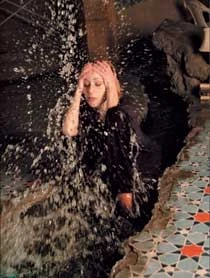
DESCRIBE Heather Raffo’s solo “9 Parts of Desire” a certain way and it has a familiar ring: The subject is Iraq, but it’s also a response to 9/11. A 90-minute mosaic of Iraqi women under siege, “9 Parts of Desire” was already a glimmer in writer-performer Raffo’s mind when the terror attacks hit this country in 2001.
Three years earlier, as a grad student in San Diego, she had parlayed interviews and conversations into 20 minutes’ worth of monologues about Middle Eastern women for her MFA thesis. Then, when George W. Bush was elected in 2000 — an event that the Michigan-born Raffo and her Iraqi father both suspected signaled bad news for Iraq — Raffo felt it was time to expand on the material.
And then “9/11 upped the ante a lot,” the New York-based Raffo says in the greenroom at Arena Stage, where this London and off-Broadway hit opened to Washington audiences in high political season last week. “I’m not saying I understand Al-Qaeda; That’s a completely different issue. But that idea of Who Are These People, What’s Going On? I thought, I have an ‘in’ on both these cultures. I have to do this.”
Half of that “in” refers to her childhood during the 1970s in the suburban Midwest, which featured only a slight sense of being part Iraqi (Raffo’s mother is American), with just one vividly recalled visit to relatives in Baghdad when she was 4. So very heartland-archetypal is Raffo’s blond attractiveness (“You look fabulous,” two different Arena staffers tell her) that the classically trained actress has had a decent career in TV commercials.
“Advil, Wendy’s, Cheerios — you’ve seen me,” Raffo says. “That’s how I wrote this play. I wrote this play on, what is it — dirty money!” She squeals with laughter. “It is very funny to me, clocking in as a young cereal mom and me going, ‘Quick, I’ve got to go interview these Iraqis.’ “
The other half of Raffo’s cultural “in” was the Iraqi heritage that didn’t really hit home until after college and a solo return, distraught about the first Gulf War, to Baghdad in 1993. She’s fully in touch with those roots these days, and was in Damascus a few weeks ago for a family wedding. (There were Syrian family connections on the bride’s side, and Damascus is safer than Baghdad.) Raffo illustrates the two halves that have come to inhabit her as she explains with a crooked grin how 20 relatives rented a two-bedroom apartment in Damascus for the occasion. Even the newlyweds crashed on the floor with the gang after a few nights alone.
“We said, ‘You have the Four Seasons!’ “ Raffo laughs. “They’re like, ‘We miss you guys, we have to come sleep on the floor with everyone!’ And I’m thinking, this is this unit. It’s not obligation, it’s choice.”
The wedding party turned into a weeks-long blowout for the families who made the trip from Baghdad. “It’s just release from that fear,” Raffo says. “They were literally partying it up. Everything was like, ‘Let’s go here, let’s go there!’ It was very hard to get them to talk about the situation in Iraq because they were having such a good time. And I hated bringing it up, but I want to know. I want to know in ways they won’t tell me on the phone.”
There is a profound family presence in the play, from a voice on an answering machine — her father’s, replicating a message from her uncle that Raffo preserved for years until accidentally deleting it — to a recitation of relatives’ names that is indeed authentic.
Yet the characters in “9 Parts” are fundamentally composites of the many women Raffo has known: The artist based on Layla Attar (once the curator of the Saddam Arts Center and Raffo’s original inspiration), a lonely Bedouin woman, a girl who merrily dances to N’ Sync and expertly handles a pistol, even the extremely Raffo-like American in New York fretting about her kin in Iraq as they worry for her.
Director Joanna Settle points out that Raffo’s script isn’t based on taped conversations or verbatim interview transcripts. “She is very much writing from the heart,” Settle says. “She doesn’t work from the news.”
It’s inevitably a newsy play anyway, packed with emotional front-line reports of the type that don’t show up in the headlines. The script gets revised from time to time, but Raffo — keenly aware of the suffering in Iraq from its war with Iran through the anti-Saddam sanctions to now — pointedly doesn’t try to keep up with the latest events; she and Settle are more interested in capturing major changes in the mood. Example: The shock of abuses by American soldiers at Abu Ghraib.
“Americans didn’t think it was possible to have Abu Ghraib,” Raffo says. “Iraqis didn’t think it was possible. That was Saddam; that was not America. So the psyche completely shifted. And the character who mentions it is American, because she feels Abu Ghraib more than anybody.”
Raffo road-tested the show in Edinburgh in 2003, then transferred to London. She arrives in Washington stamped with international approval, and the play already has been produced in regional productions featuring other actors. Settle says, “It’s never going to go out of date, because there are always going to be women in the middle of war trying to live their lives.”
Raffo has clearly been changed by the long, unexpected process of creating and performing “9 Parts of Desire,” which takes its title from an ancient Shiite proverb: “God created sexual desire in 10 parts; then he gave nine parts to women and one to men.” On the one hand, the show reflects an internal curiosity, which eventually grew consuming, about Raffo’s own Middle Eastern ties. As women she spoke with unleashed torrents of feeling, “I realized the things I craved, the way I sort of moved through the world, certain aspects of my feminine psyche — ‘Oh, I’m just like these people,’” she recalls.
At the same time, the actor began to find herself as a writer. Raffo has more plays in mind, some with Middle Eastern themes, others without. Not surprisingly, the Iraqi material is pressing hardest.
“There’ve been two wars in Iraq in my short lifetime,” Raffo says soberly, referring to the two US-led Gulf wars. “This is wild. So I have to get at this. Because it’s not like my dad’s family from way back came from Iraq. They’re there right now, and they can’t get out. This is the discussion I was trying to have in Damascus: Get out now. It’s on its last legs.”
Disintegrating whether the US stays in, increases troop levels, or pulls out now? Raffo waves her hand dismissively, as if shoving aside a stale “Crossfire” policy debate and keeping the focus on her people.
“It’s as bad as it’s ever been,” she says flatly. “And they know it.”