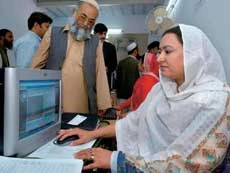
ISLAMABAD, 16 October 2006 — Authorities began yesterday to register Afghan refugees for the first time and to provide them with official identification during their temporary stay in the country.
The government exercise, helped by the UN refugee agency, is a follow-up to the 2005 census of Afghans who fled to Pakistan after Dec. 1, 1979 to escape the Soviet invasion of their homeland.
“Only Afghans included in the census can take part in the registration,” said Nayar Agha, the Chief Commissioner for Afghan Refugees in Islamabad.
“For them, registration is mandatory and they will get a Proof of Registration (PoR) card at the end of it.” The 10-week program will be conducted through 90 centers supported by mobile registration vehicles across Pakistan. United Nations High Commission for Refugees (UNHCR) and government officials are verifying names against the census database and monitoring the whole process.
So far, more than 4,000 Afghans have been registered in pilot exercises in northern Chitral and eastern Jhang districts that started on Oct. 1, the UN refugee agency said.
“More than 2.8 million Afghans have returned home from Pakistan since 2002. Another 2.5 million are believed to be still living in Pakistan,” Indrika Ratwatte, the UNHCR’s assistant Representative in Pakistan, said.
“Within the three years of the PoR card’s validity, we hope to be able to find more durable solutions to this protracted situation,” she said in a statement.
“Starting next March, we will introduce new repatriation arrangements tied to the PoR card to help returnees in their area of origin,” it said. The registration exercise, which cost six million dollars, is expected to be completed by Dec. 31.
Pakistan has been encouraging the voluntary repatriation of Afghan refugees under a UN-assisted program following the 2001 ouster of the Taleban regime in neighboring Afghanistan.
It has closed refugee camps in its tribal areas bordering Afghanistan to beef up security in the region, but tribesmen frequently cross the border to meet family members or for trade on both sides.
Pakistan has deployed 80,000 troops in its tribal area to check cross border movement of Taleban and Al-Qaeda linked fighters and has also entered a deal with tribal elders in North Waziristan to expel foreign militants.