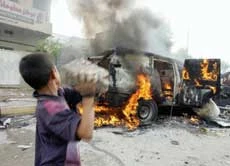
BAGHDAD, 17 October 2006 — The Iraqi people were caught up in an astonishing spiral of violence yesterday, battered by bombs and stalked by death squads, as an embattled government struggled to remain in control. US President George W. Bush was forced to issue a statement reiterating his support for Iraq’s beleaguered leader, Prime Minister Nuri Al-Maliki, amid talk in Washington of the need for a radical change in strategy.
Such talk has been fueled by a steady increase in military casualties, and yesterday alone seven more deaths were announced, bringing the total number slain in October so far to 57, three weeks ahead of key American congressional elections. The grim Iraqi civilian and military toll continued its steady rise yesterday with at least 49 people killed, as sectarian bloodletting raged across the country.
As night fell in the capital and Muslims gathered to break their daylight Ramadan fast, two massive car bombs detonated in a mainly Shiite suburb, scattering 20 bloodied corpses in the streets. Further north, a brutal wave of sectarian slaughter gripped districts around the town of Balad, where hospital staff reported receiving 80 corpses, mainly Sunni villagers gunned down by Shiite death squads.
Already before the month of Ramadan began more than 100 Iraqis were being killed every day. Two weeks later Iraq is gripped by the worst violence it has seen since the US-led invasion of 2003 toppled the regime of Saddam Hussein. A review of the situation by a bipartisan US committee of experts headed by former Secretary of State James Baker is expected to recommend a change in US strategy for rebuilding Iraq.
Amid the carnage, however, there have been signs that Iraq’s most dangerous elements are thinking about taking a step back from the brink of all out conflict, albeit not in ways that might reassure the Iraqi regime. Outside the northern oil city of Kirkuk, which was ravaged by multiple suicide bomb attacks over the weekend, a masked militant representing the nationalist insurgent group the Islamic Army called for talks with US forces.
Against this background, Bush’s spokesman Tony Snow told reporters that the US president had called Maliki to reassure him. “The president said, ‘please don’t worry, and you have our full support’,” Snow told White House reporters.
“The president underscored his commitment to the democratically elected government of Iraq, encouraging the prime minister to ignore rumors that the US government is seeking to impose a timeline on the Maliki government.” Maliki’s own frustration with his US sponsors boiled over in an interview with the daily USA Today, in which he blamed coalition administrators for the weakness of Iraqi security forces.
An alliance of Sunni tribal sheikhs meeting nearby also distanced themselves from Al-Qaeda, but called for Saddam to be returned to power. Supporters waved portraits of Saddam and called for his release, calling him the “legitimate president.” Saddam himself appealed for the insurgency to be “just and fair” to the Iraqi people, in a note delivered by his lawyer Khalil Al-Dulaimi.
Shiite militiamen blew apart a British Embassy SUV with a rocket-propelled grenade in Basra, as night fell Sunni assassins killed the brother of the lead prosecutor in Saddam’s trial as he fled his home in the capital.