
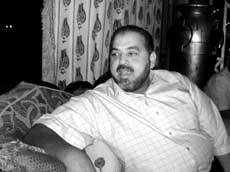
JEDDAH, 17 October 2006 — One of Britain’s highest-ranking Muslims, Nazir Ahmed of the House of Lords, visited Saudi Arabia as a guest of the Kingdom of Saudi Arabia last week. In an interview with Arab News, he expressed grave concern about the future of Middle East-West relations, but he also took pride in the freedom that Muslims in the United Kingdom enjoy and in the friendship between his nation and Saudi Arabia — a friendship based on mutual respect and understanding.
Forty-eight-year-old Lord Ahmed was born in Mirpur in Pakistani Kashmir but was brought up in the UK. He studied Public Administration at the University of Sheffield and joined the Labour Party at age 18. He recognized the importance of grass-roots politics and founded the British Muslim Councilors’ Forum in 1992. He was made a Justice of the Peace in the same year and chaired the South Yorkshire Labour Party for several years. In 1998, he was made Britain’s first Muslim peer and named Baron Ahmed of Rotherham in the County of South Yorkshire. That same year, he was appointed to serve in the House of Lords.
“I am a proud British Muslim,” the baron said. “No other country gives Muslims as many rights as my country gives me.” He, however, acknowledged that tensions have increased outside — and inside — the Muslim community in the UK because of the anti-terror laws and the “illegal” and “immoral” wars in Iraq and Afghanistan. “Since July 7, 2005, things have gone from bad to worse, although after Sept. 11, 2001, things were difficult for the Muslim community in the United Kingdom,” he said. “I still say that we have better conditions and better facilities for Muslims in the United Kingdom than anywhere else in the world — in terms of rights, in terms of equality and in terms of representation in Parliament. Nevertheless, things became difficult because, on the one hand, we have extremists like Abu Hamza Al-Masri, Omar Bakri Muhammad and Abu Qatada who portray a version of Islam that has more to do with their twisted political ideologies. Their voices were presented (by the media) as if they represented the entire Muslim viewpoint. They don’t represent Muslims; they represent only a fraction of the Muslim community. But the media was more than eager to sensationalize stories, and their (the extremists’) comments came in handy.”
Lord Ahmed said British foreign policy has made a bad situation worse. “On the one hand, you have the war in Iraq and the war in Afghanistan,” he said. “Now we are living in a different world. This is a world connected by media images. Now you see in real time what is happening in Baghdad, what is happening in Kabul. And that affects everybody. Muslims are not the only ones who are outraged at what is happening. More than 50 percent of the British public is against the war in Iraq. It has been calling for the withdrawal of British troops and telling Prime Minister Tony Blair that his policies are dead wrong.”
Lord Ahmed has used his high-profile position to make his opinions known in an open letter to Blair. He feels that British foreign policy has been instrumental in the growth of radicalism among British Muslims. “What we were basically saying was that we believe that human values — wherever they are — are equal,” he said. “So human values in the streets of London, in the streets of New York and in South Lebanon are all equal, and we must maintain the same standard. We should have been asking for an immediate and unconditional cease-fire in Lebanon. We should also be condemning those who are responsible for the killing of innocent children in Gaza. What we said in that letter was that we have to be even-handed. If the government thinks that the wars in Iraq and Afghanistan have nothing to do with the rise in militancy among Muslims, then it is wrong.”
Lord Ahmed expressed disappointment in Pope Benedict’s recent lecture that inflamed passions with its intolerant characterization of Islam. “I believe in a dialogue of civilizations,” he said. “Even the pope seems to be following the line of Bush and Blair. That is frightening. And this is why when people were calling for an apology, I will say here in Jeddah, and I said it in London, that I wasn’t asking for an apology — I was asking for understanding; I was asking for a dialogue. Because an apology is from someone who doesn’t change his mind, who believes in something but just apologizes to please you. What I am saying is that we respect Jesus Christ as one of the holiest of prophets God created; we respect Mary as one of the purest women on Earth; we respect the Bible and we believe in the Bible. Therefore, all we say is please do the same with our Prophet Muhammad (peace be upon him) and the Holy Qur’an. Accord our Prophet the same respect. That can only come through dialogue and understanding.”
Lord Ahmed hopes to advance that dialogue through an all-party interfaith committee composed of members of both houses of Parliament of which he is chairman. “We have very good representation there from across the entire political spectrum. We just need good people,” he said. “If there are good people prepared to sponsor something big, I would be very happy to organize a conference to which we could invite the Archbishop of Canterbury, the head of the Catholic Church, the chief rabbi and some of the most important Muslim scholars in London. Let us start with understanding between the Abrahamic faiths. It has to be in London or Washington — a conference where we can say we respect Moses — one of the greatest prophets — and all the sons of Abraham.”
Lord Ahmed doesn’t see much of a change in direction if Gordon Brown replaces Blair but notes that the British system of government allows for change, and Brown may not be a shoo-in. He also believes in his Labour Party as the best way forward for the UK if it remembers the basic policies with which it has traditionally been associated.
“British politics is a very strange game,” he said. “I think Labour needs to consider that if we are going to be a reforming and modernizing party, we can’t do it with old people. To be fair to the Labour Party, it had a very reforming agenda, and we have done well — unemployment is at its lowest; interest rates are at their lowest. The economy is doing very well. I think where we probably have failed our people is the inequality between the rich and the poor and the difference between the socially and economically deprived isolated communities and those who are doing well. Remember that Britain is the fourth-richest country in the world. I believe that all communities should be enjoying the wealth of the nation, rather than just a few at the top. Therefore, there has to be a way that we engage with the white working class, the ethnic minorities and especially the Muslim communities.”
The British society Lord Ahmed envisions is a pluralistic society where people of all ethnicities, religions and beliefs can live unhindered and peacefully. “Some of our communities are from Sylhet (in Bangladesh) and Mirpur (in Pakistan). They are the largest groups,” he said. “Both these communities are very much connected, connected to their own communities back home and disconnected from mainstream society in the United Kingdom. They have not been able to give identity to their children; they have not been able to integrate because they have never seen Britain as their first home. There is also racism in society. Yes, there is racism. Like all immigrant communities, these Mirpuris and Sylhetis have tended to live together to protect each other. We have a problem with schools. We have schools with 98 percent ethnic minorities, say Bengalis or Pakistanis or Africans; all children speak their native language; they do not speak English so they will not be able to integrate into society. Some of their social problems have also meant that the education standard has been very low, and because their education standard is low, then they find it difficult to go into good jobs. So there is high unemployment. When you have high unemployment and underachievement, then you have social deprivation. And when you have social deprivation, then there is social exclusion, too.”
Lord Ahmed says there is a disconnect between government policies and some of these communities. “I think the government has failed in this important area,” he said. “The government’s job was to try and regenerate those communities — to make sure that those communities are also part of the mainstream society, and that they also benefit from the fourth-biggest economy in the world. These people have given their blood and they have given their sweat for the economy. When we have had difficulties and problems, say in the coal industry or the steel industry, when those communities needed to be regenerated we put billions of pounds to regenerating them. But what happens when we have these problems in the Muslim community, the Bengali and Pakistani Mirpuri community? The government hasn’t done the same. We needed money being invested there for it to be regenerated, and that has not happened. That is where the government has failed.”
Lord Ahmed’s sentiments echo recent voices from the Organization of the Islamic Conference (OIC) for better media representation for Muslim perspectives. “The Muslim world needs to learn that we must have thousands of good media graduates,” he said. “Muslim students need to take up media studies. You need to have Muslim students who are excellent in English, in French, in German, and they need to be from Saudi Arabia, Pakistan, Bangladesh and the entire Muslim world. Then you need to export them. Rather than exporting some of these extremists, we need to export good, intelligent media people who can write good articles explaining our point of view.”
Lord Ahmed said recent events in Lebanon had demonstrated his point. “We didn’t have well-trained, articulate spokespeople,” he said. “During the Israeli war on Lebanon, what was happening was that, apart from Al-Jazeera and Al-Arabiya, on CNN, BBC and all the other TV channels, you had all these Israeli commentators and politicians dominating the airwaves. Shimon Peres and that horrible man Benjamin Netanyahu. They were all in London every other day, shuttling from this studio to that studio advancing their points of view. And what were they saying? The same thing — that they are fighting terrorists. Yet there was nobody from the Arab and Muslim side to call their bluff — to expose them. There was nobody who could argue cogently against their rhetoric. Except for that Christian lady from the West Bank, Hanan Ashrawi. She is fantastic as a spokeswoman. We need hundreds of Ashrawis who can go on air and explain what the real situation is. Also, let me say this with emphasis: There is a lot that this region needs to do. It has to open up. When there is pressure, this region closes up. And clamming up doesn’t help. Because when there were problems in south Lebanon, there was a meeting in Malaysia convened by the OIC. Not a single head of an Arab state attended it. We need to show some solidarity.”
Lord Ahmed also notes the chasm between the Arab leadership and the Arab street. “The streets have no say in the UN Security Council,” he said. “We need Arab heads of state who clearly say: ‘Enough is enough.’ The least that this region can do is to set up think-tanks in London, Paris, Washington and Berlin. Fund those think-tanks in order for them to articulate our point of view. Let them organize debates on our behalf. You need to have that. Otherwise, we will have a divided world.”
Despite the challenges facing British Muslims, he says the country’s majority need not worry about its fellow countrymen. “Ninety-five percent of the British Muslims are proud British citizens,” Lord Ahmed said. “They take responsibility as citizens. I am sitting in Jeddah, and I can tell you that as a proud British Muslim, I have more rights in Britain than anywhere else in the world. No other country gives Muslims as many rights as my country gives me. Even with all the difficulties after the July 7, 2005, bombings we are well off. I can stand up and criticize Blair, and I can criticize any minister. I can use some very harsh words against my government without any fear of disappearing the next morning.”