
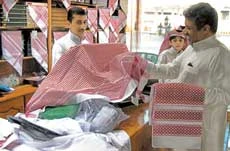
BOTH the shumagh and ghutra have been traditional headdress in the Middle East for more than 2000 years. They have survived and more or less preserved their traditional forms and colors; there has been little “interference” from the vagaries of changing fashion. Though people in the Gulf have worn shumaghs for a long time, they were generally unaware that the articles came from abroad — particularly from China and England. Indeed it has only been in recent years that Saudi businessmen have tried to establish factories for the production of shumaghs in the Kingdom.
Saudis spend a good deal of money every year to buy some 12 million shumaghs. As with all other products in the Kingdom, original shumaghs suffer from “fakes.” According to the media, this competition results in losses of SR5 billion annually. In addition, the competition forces many local manufacturers to exit the scene. Customers also are affected since they often spend good money on low-quality shumaghs. Saudis are now very aware of quality and are on the lookout for good products of high quality. Most Saudis can easily and quickly distinguish between what is original and what is not — and in the end, it is up to the buyer to choose what he needs. Saudis have an intimate relationship with their shumaghs and so look for the best. Both local and international companies provide different designs in Ramadan; the companies give every design a different name so as to attract a variety of customers.
The majority of shumaghs sold in the Saudi market are unfortunately fake; they are low priced, mostly made in southeast Asia and they affect the value of the traditional article. Selling shumaghs on the street and outside mosques or at traffic lights turns a highly valued product into a worthless one. The shumagh is a vital part of the dress and image of a Saudi man. It represents his character and reflects his personality. Above all, it is culture and tradition.
Omran bin Riyadh Al-Maliki, the general manager of Desar Trade and Promotion Company, a local company that produces and sells Shimags said, “We have been working for years to produce what fits, suits, and satisfies men who are careful about what they wear. We have a group of designers who design what suits the Saudi man’s lifestyle. Our Desar 2007 satisfies the plucky, ambitious, honest man who confronts challenges and who is confident of himself.”
Al-Maliki also added that knowing the history of the shumagh is not enough to start making them. The historical background goes hand in hand with following the new designs appearing in the market. “Our company has proved that it is a leading company. Furthermore in Desar shumaghs you will find a mixture of beauty, high quality, and tradition. This is what we aimed for and this is what we have achieved.”