WASHINGTON, 8 November 2006 — President Bush has long told the American people that he is “the decider” when it comes to American policy. But yesterday the voters were the deciders.
As polls opened, Bush and his aides insisted he was not worried. But political observers note that few deciders have gone through a period when so many decisions seemed out of their hands: Bush told North Korea not to test nuclear weapons, but Pyongyang detonated bombs anyway. He told Iran to stop pursuing nuclear weapons, only to have Tehran thumb its nose at the United States. He ordered his generals to find a way to stabilize Iraq, but bombs and bullets took more US lives in October than any other month in two years.
So, as Americans voted yesterday — and initial reports said polling stations were busy — national security and the Iraq war remained the leading issues of midterm elections in which national issues, not local ones, have framed the most competitive races.
Democrats have said a vote for them would force change in Iraq strategy, while President Bush has led the GOP charge in warning constituents that the opposition party cannot be trusted in time of war.
Unlike in the 2002 and 2004 elections, when Republicans held a decisive edge on national security, polls over the past year have shown the public losing faith in the war and the GOP, and Democratic candidates nationwide used their last TV advertising dollars on spots critical of Iraq policy.
Americans were voting to decide whether to give Bush back a Congress that stands by him or to turn one or both houses over to the Democrats to force change. In the Senate, Democrats will have to gain six seats to win a majority, and all but one of the most competitive races are in the East or Midwest: Virginia, Tennessee, Missouri, New Jersey, Pennsylvania, Rhode Island, Ohio and Maryland.
The three tightest Senate races, where pollsters say they are “too close to call,” are in Missouri, Virginia and Montana.
Most of the tight House races are also located in states east of the Mississippi River, where Republican candidates in Connecticut, New York, New Hampshire, Pennsylvania, Kentucky, Indiana and Ohio will soon know whether Democrats won the 15 seats they need to take control of the House.
Because the key races in Congress are concentrated in the Eastern and Central time zones, and most polls close at 8 p.m., observers predict that they will soon know how America decided.
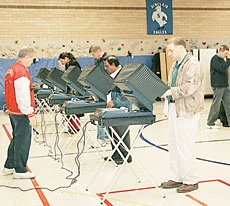
That is, if everything goes smoothly. But voting machines began causing trouble the minute the polls opened, delaying voters in hundreds of precincts and forcing some to use paper ballots instead. In Cleveland, voters rolled their eyes as election workers fumbled with new voting machines that they could not get to start properly.
Election officials in Delaware County, Indiana, planned to seek a court order to extend voting after an apparent computer error prevented many voters from casting ballots.
Delaware County Clerk Karen Wenger said the cards that activate the machines were programmed incorrectly.
Throughout the country, American Muslims have been urged to vote. The Muslim American Society, MAS, says it has been phoning Muslims nationwide to remind them to vote. “The calls are being heavily targeted toward districts where there is a large Muslim population and heavy Muslim turnout could make a significant difference in the elections. Virginia, Florida, New Jersey, Ohio and Texas are a few states that have been targeted,” said a spokesman at the Washington-based MAS, adding that they are also offering transportation to the polling stations.
Bush urged Americans to vote as he cast his ballot. Bush and his wife Laura, having spent the night at their ranch in central Texas, voted in polling booths set up inside the Crawford fire department building.