
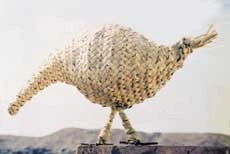
IN some countries like Egypt and Saudi Arabia, palm tree products have been traditionally used since earliest times to make handicrafts for domestic use. The wood of the trunk is used for roofing, the fibers for mats, fans, baskets and the leaves for brushes and ropes. Egyptian-born Ahmed Askalany has turned a rural craft into a genuine art form. His novel practice of weaving palm leaves over metal frames has earned him instant success. His original sculptures have generated unprecedented attention especially in Europe where they have been exhibited in Italy, France, Bosnia and Holland.
Ahmed Askalany is self-taught and it is precisely this lack of academic training that makes his work so original. Each piece has a unique character and a certain unusual liveliness. A row of believers bowing to God symbolizes the power of prayer. A mere glimpse of the plump chicken, pecking and cackling, evokes images of a blissful rural life.
The artist’s main inspiration stems from his family’s native village, Nagaa Hammadi, some 650 kilometers south of Cairo. Happy childhood memories unleash a bottomless well of ideas, shapes and colors. From the age of six, Askalany remembers how he gathered palm leaves and palm branches and shaped them into animals. It was not until he became a student in the Faculty of Agriculture that he decided to become a potter. His first attempts to enter the artistic world were repeated failures. On three occasions his work was refused for exhibition. He decided to try one more time and made up his mind that if he failed, he would finally give up his dream of becoming an artist and work on his family’s farm. He was awarded a first prize and the success not only boosted his confidence in his artistic ability but it also reasserted his belief that his search for an art form was firmly rooted in his rural environment.
A formidable sparkle emanates from these deceptively simple palm leaf structures. One is left wondering how the plain, unadorned compositions can radiate so much energy and trigger such complex feelings in the viewer’s mind. The secret lies in the artist’s touch. Askalany works as much with his hands as he does with his mind. Nothing is done by chance. First, the idea for each one of his pieces is carefully crafted and designed. Then, he gives it a concrete form by shaping it with the help of metal frames which act as a skeleton. Finally, he assembles and chooses dried palm branches. He moistens them with water so as to increase flexibility and begins twisting the palm leaves into the desired shape. Finally, the form will be fitted like a layer of flesh onto the metal skeleton. A glimpse at the dog literally racing across some imaginary street highlights the extraordinary metal assembly lying underneath. It is the artful positioning of the metal rods which gives the sculptures a dazzling vivacity and a dramatic aura of truth.
Askalany has transformed the ancestral craft of weaving palm leaves into a subtle art in which the simplicity of form reveals a complex web of emotions. In our lives, increasingly dominated by high technology, we crave nature’s soothing touch. The artistic scene has too often given way to highly abstract art disconnected from our lives and innermost aspirations. Askalany’s works of art display a dynamic vision of reality which answers our growing quest for a simple life in which nature will once again take its rightful place.