
Kerala is the jewel in India’s crown. This is no exaggeration, no hyperbole, no false praise. Historically, politically, culturally and in terms of natural beauty and variety, Kerala (or Keralam as India’s southern most state is to be called henceforth) represents a microcosm of India at her best.
The first thing that strikes anyone about Kerala, popularly called “God’s Own Country” is her incredible natural beauty. God was surely in His most generous mood when He created Kerala. This tropical paradise of myth and mist, legends and lagoons, is India’s greenest state. Nowhere else will you find such a stunning variety of shades of green — the light apple green of paddy fields, the mossy green of the grasslands, the darker green of the luscious leaves of tropical trees, the bottle green of dense forests and the blue-green of the verdant mountains.
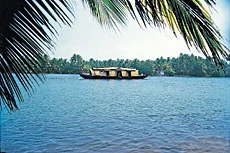
Like the earth with its variegated shades of green, the water too has different colors. Kerala has a rich variety of water bodies — sea, rivers, streams, lakes, backwaters, waterfalls. Sometimes the water is colorless. Sometimes it is blue, reflecting the sky, sometimes it is dazzling white. During the monsoons, rivers can turn an angry red as the red-colored soil is washed away in the torrential rain. Often the water is green, reflecting the surrounding greenery. Kerala’s lush greenery is a constant reminder of the sheer abundance, bounty and fertility of nature. The joke in Kerala is that if you toss a mango seed out of your kitchen window, before you know it, a tree has grown. It’s not entirely a joke. The fertility of nature has to be experienced to be believed.
Very few regions of the world offer the variety of nature that compact Kerala offers: golden beaches, frothy ocean, gently rippling backwaters, placid lakes, crystal clear lagoons, picture postcard ponds, roaring waterfalls, lush plantations of rubber, coconut, rice, tea, coffee, pepper and cardamom, exciting wildlife sanctuaries, enchanting coral reefs, mysterious mountains, butterfly trails and dense forests. A Kerala jungle is a miniature Amazon. Giant trees with leaves as broad as salvers, tree trunks black with age and heavy with fruit, thick undergrowth that jostle for sunlight, wild flowers and spices that fill the air with a heady scent. You have it all.
Another striking aspect of Kerala is its rich and unique culture. Unlike many wonderful tourist destinations of the world, Kerala is a living entity. Many must-see global tourist hubs are monuments of the dead or a tribute to the past. They are reminders of the glories of a bygone era or a collection of architectural marvels of the past — forts, mausoleums, museums, castles and cathedrals. But Kerala represents a rich mosaic of culture that is alive and pulsating.
This unique culture is represented by Malayalam, the language that unites all the people of Kerala, no matter whether they are Hindu, Muslim or Christian, rich or poor, Communists or Centrists. It is manifested in Malayalam literature, the magnificent dance traditions of Kathakali, Theyyam, Kodiyattam and Mohiniattam, the variety of art, theater, music, martial arts, folklore, cults and legends.
Ancient methodologies — from Ayurveda (Hindu traditional medical system) to oil massages, from occult to the science of architecture, are still a vibrant part of modern life. Kerala has a unique architectural tradition that is evident in temples and ancestral homes — tiled roof in pyramid style, wooden lattices, louvered windows, mud brick walls and inner courtyards that keep the interiors cool and tranquil. The unique culture is also manifested in the amazing array of secular and religious festivals. The Thrissur temple festival with its ornately caparisoned elephants is as much a must-see as the annual snake boat race in Alleppey, where hundreds of wiry, lithe traditional Kerala oarsmen race along the backwaters in rapid, rhythmic strokes to the sound of song and drumbeat.
And then there is the mouth-watering Kerala cuisine. Most foreigners who go to Indian restaurants abroad don’t realize that what they are eating is invariably north Indian food. But Indian cuisine has amazing variety — Bengali food is as different from Gujarati, Kashmiri as different from Kerala food. I could be accused of partiality, but after having tasted dishes from around the world, I am convinced that no cuisine is as delicious or nutritious as Kerala cuisine. Unlike north Indian food that is heavy on oil, cream and powdered masala (blend of mixed spices), Kerala food is light with minimum use of oil and garnished with plenty of natural herbs and spices such as garlic, ginger, onions, chillies, tamarind, coconut, curry leaves, cinnamon, cloves, cardamom and a variety of seeds that provide essential nutrients to the body — fenugreek, mustard, fennel and cumin. Food is not only delicious, but therapeutic. They are natural medicines. While cloves are good for toothache, ginger, turmeric and other spices are excellent for coughs and colds. Some local fruits are excellent cures for constipation, while others are effective for diarrhea.
As with most other Indian cuisine, Kerala has a rich tradition of hot, freshly made breakfast food which is completely different from lunch and dinner menus. There is also a rich variety of snacks and desserts. As with the landscape that offers a rich variety, so too with the foods. I have seen tasty vegetables and juicy, delicious fruits in Kerala that I have not seen anywhere else in the world — this is apart from the mangosteens, pineapples, rambutans, catfruits and jackfruits that can be found in other tropical countries. Likewise, I have never seen such a variety of potassium rich bananas anywhere else in the world. I have myself counted 17 different varieties — red, orange, green, yellow in different shapes and sizes, each with its own distinct flavor and texture.
Kerala has a fine culinary tradition in cooking vegetables, meat and fish, the Hindu, Christian or Muslim way. Each religious group has its own delicacies that cannot be found anywhere else in India or in the world. The variety of shrimp preparations is truly mouth watering. And as another joke goes, while the rest of India worships the cow, Kerala worships beef. That’s because while one-third of Kerala’s population is Hindu, another third are Christians and the remaining third are Muslims. While the cow is sacred to Hindus, Christians and Muslims love beef. It is a measure of the spirit of tolerance that while cow slaughter is banned in most other Indian states, it isn’t in Kerala in view of the large Christian and Muslim populations.
Kerala has much to teach the world. It is a microcosm of multiculturalism. Today, Europe and America are struggling to deal with multiculturalism that works. Unfortunately, in the West, multiculturalism has evolved into segregation, a kind of ghettoization, whereby the whites, browns and blacks live in their own little conclaves with little mutual contact or integration. In Kerala, all religious, social and ethnic groups have their own distinct identity.
For instance, Hindus, Muslims and Christians all maintain their own special marriage customs, social taboos and sartorial traditions. But all live together in close proximity in a spirit of live and let live. Language (Malayalam), heritage, garrulousness and the love of their land are perhaps the only common factors, but it is sufficient glue for peaceful coexistence.
Politically, too, all shades of opinion coexist. Liberals, fundamentalists, devotees, atheists, extremists, secularists, right-wingers, left-wingers, Marxists, socialists and capitalists all clamor for political space. There is no dearth of opinion or discussion in the state. Yet another joke in Kerala is that if four Malayalis assemble, five trade unions will be formed.
What makes the Kerala of today so genuinely pluralistic, tolerant and multicultural is its history. For more than 2,000 years, anybody who was a somebody in history has arrived on the shores of Kerala and left their mark — Phoenicians, Arabs, Jews, Chinese, Polynesians, British, Portuguese, Dutch. They have all come and gone, but always left something behind too. Kerala has given spices and much more to the world. But it has also absorbed some unique features of each visitor — whether it is the architecture, cuisine or religion. And then transformed it into something distinctly Malayali. Through history, Kerala has also given sanctuary to many fleeing foreign refugees, even from as far away as Mesopotamia, and provided them an enabling environment to become thriving citizens of the state.
Vasco Da Gama, the famous Portuguese sailor thought he brought Christianity to India in 1498. Little did he know that Kerala had Christians for 1,500 years before he stepped foot. Christianity had struck roots in Kerala a full thousand years before it spread across Europe. St. Thomas, a disciple of Christ, arrived in Kerala in 52 AD and many upper caste Hindus. The oldest living Christians, the Mar Thomites, date from that period and continue to flourish as a vibrant community in Kerala. Churches, temples, mosques and synagogues exist side by side in this gem of a state. Though one of India’s smallest states, Kerala has enough in its treasure trove of history, culture, cuisine and landscape to make anyone green with envy. The natural beauty of this exotic land is breath taking. It is the greenest haven in India and one of the greenests in the world. So now you see why I am not exaggerating when I say Kerala is India’s jewel. Indeed, Kerala is the sparkling emerald in India’s crown.