JEDDAH, 12 November 2006 — The second Jeddah Water and Power Forum opened yesterday with authorities assuring the public that plans and strategies were being worked out to meet the growing requirement of water in and around the city.
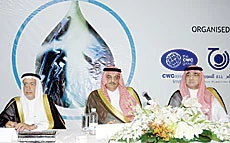
Prince Abdullah ibn Fahd, deputy governor for security affairs, Makkah region, formally opened the forum at Jeddah Hilton in the presence of Minister of Water and Electricity Abdullah Al-Hussayen, Jeddah Chamber of Commerce and Industry’s Chairman Saleh Al-Turki and Adil Bushnak, forum president and chairman and CEO of the Bushnak group.
At a pre-forum seminar held earlier in the day, speakers offered solutions to what they saw as the critical stage of the water industry prior to privatization.
Some speakers, including Tarek A. Taher, president and CEO of Aal Taher group, called for an integrated water and power production strategy that would protect the environment and discussed methods of conserving fresh water and recycling waste water in ways that did not affect the environment.
“We cannot,” said Adil Bushnak, “make decision-makers change their minds, but we can put ideas into their heads.”
The critical importance of the future of water both in the Kingdom and the Arab world surfaced in discussions through the session. Rami Makhzoumi, president and CEO of Future Pipe group, said that there is a lack of ability in the Arab world to communicate exactly how critical the situation is. “The water issue is the only one that creates interdependency among Arab states,” he told delegates during a question-and-answer session.
Fouad Makhzoumi, chairman of the Future Pipe group, said that water specialists had to spend money on developing the data to present the facts of the situation to the decision-makers, but in a “nonpoliticized version.” He said that presented this way, Arab governments would adopt it in a way that other Arab governments would not look for a hidden agenda.” He added that water specialists needed “to move reform in a positive and constructive way rather than a revolutionary way.”
Ghassam Ejjeh, former president of the IDA and director of Besix who chaired the session, questioned the current use of water and put a moral slant on the need to develop both use and water storage. “What right,” asked Ejjeh, “do we have to steal the resources of our children and grandchildren by over-pumping?”
Makhzoumi noted the lack of strategic capacity for the storage of water in the Gulf states and the risk to water security this represented. Kuwait has 10 days of supply in reserve but, he said, for the rest the level is “typically one day.” The technology to store water in aquifers is available, he suggested, and he thought that there was little use of recycled water in the region.
The panelists agreed that privatization was the way forward. Despite the examples of the UK and Colombia where privatization saw massive price increases to the end user because of the cost of installing or refurbishing infrastructure, the cost of building water infrastructure had risen beyond the means of any government.
Helmut Weidel of AMI Water presented an overview of a solution to the challenges of joint ventures between governments and private investors. “Water is a commercial good,” he said, “but has a political aspect, especially in South America.”
A core element of the global model was a “transparent treasury” that continuously communicated the elements of any public-private partnership to end users. The public sector, he said, should be seen as a partner, “not just as someone who develops the framework” to facilitate privatization.
He said that, according to a World Bank survey in the 1990s of 121 water projects in 49 countries, only eight percent of projects with low private participation were successful.
The three-day forum ends Tuesday.