
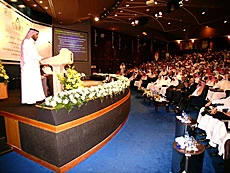
DAMMAM, 20 November 2006 — Saudi Arabia is poised to become one of the world’s petrochemical leaders in the coming decade, creating thousands of jobs as new industries emerge to take advantage of the Kingdom’s oil wealth, a SAGIA official said yesterday.
Dr. Abdul Wahab A. Al-Saadoun, energy sector director general of Saudi Arabian General Investment Authority (SAGIA), made the remarks during the Saudi Energy Forum, where an international group of investors, business and industrial leaders gathered to examine future opportunities in the Kingdom.
“The petrochemical industry is the cornerstone of the diversification drive that Saudi Arabia launched in the mid-1970s primarily to reduce the reliance of the national economy on volatile oil revenues,” Al-Saadoun told delegates. “Since the commissioning of the first plant in 1983, this industry has maintained a consistent and exponential growth pattern.”
Al-Saadoun noted the country’s advantageous energy costs give petrochemical businesses a significant edge over competitors in other parts of the world.
Those prices can result in creation of petrochemical products at savings that can reach into the hundreds of dollars per ton, which gives the country a unique position in the global economy.
“The key reasons for success have been, first and foremost, feedstock cost advantage, as almost 60 percent of the integrated cash flow is hydrocarbon based, and economy of scale has been fully exploited by the Saudi petrochemical producer. The Saudi producer has always been competitive on a global level, and they are even more competitive with the healthy oil prices we see today,” he said.
The Kingdom already is the global leader in terms of cracker capacity, which is the part of the refining process that extracts petrochemicals from feedstock gases, such as butane and ethane.
Those processed materials also present the opportunity to manufacture an incredible variety of products, from fertilizers and appliances to clothing and plastic items at prices that could allow the Kingdom to become an exporter of much more than energy products, such as crude or refined petroleum.
Current projects, both on the Red Sea and the Gulf, are expected to dramatically increase the Kingdom’s industrial output in the next decade.
“Output has increased tenfold over the last 10 years and is now at 40 million tons per year,” Al-Saadoun said. “It demonstrates an annual growth rate of about 12.2 percent, which is significant by international standards. This trend is likely to intensify in the next five to 10 years with an added capacity of 55 million tons in the next five years alone. This will extend to global share of Saudi Arabia from 7 percent now to more than 15 percent by 2010.”
The Saudi Energy Forum is organized by the Ministry of Petroleum and Minerals in cooperation with the Eastern Province Chamber of Commerce and Industry and CWC Associates Ltd. Principal sponsors are Saudi Aramco and Saudi Basic Industries Corp. (SABIC).