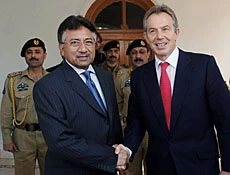
ISLAMABAD/LAHORE, 20 November 2006 — Pakistan and Britain pledged yesterday to strengthen bilateral relations and boost cooperation in anti-terror war.
Britain will double its aid to Pakistan to fight radicalism by reforming madrasas and contributing to measures aimed at supporting moderate forces.
British Prime Minister Tony Blair and President Pervez Musharraf also agreed that a military solution was not enough for Afghanistan. The situation warranted a multidimensional approach to address the problems. The issues of rehabilitation, development, education, creation of democratic environment and improvement of economic condition should be addressed to prevent Talebanization and extremism from taking hold, they said.
Blair, after holding talks with Musharraf in Lahore, said the bulk of the money from Britain would target madrasas.
Musharraf and Blair, who is making his third visit to Pakistan since the Sept. 11, 2001 attacks, also agreed that defeating Taleban insurgents in neighboring Afghanistan was crucial.
“This terrorism that we’re facing... has been a long time growing and it’s going to take a long time to defeat it,” Blair told a joint press conference with Musharraf in the eastern cultural hub.
Musharraf is an “example for the future of Muslim countries the world over” because of his anti-terror stance and the talks “opened another chapter” in Britain’s relations with Pakistan, which are at their best ever, he said.
“We are going to be doubling our support over the next three years for the program of enlightened moderation that President Musharraf has led,” to 480 million pounds ($909 million), he said.
Blair said the West and its allies were “in the midst of a difficult global struggle” against extremism and warned that the only way to win was to back moderate forces in countries including Afghanistan and Iraq.
To a question Blair said, “We are satisfied with the role Pakistan is playing in fighting extremists and terrorists that is why relations between Britain and Pakistan are on the rise. All of us are facing threats of extremism. We have to take necessary security measures. Yes, Taleban are a problem and we have a strong will to face the problem and solve it.”
He said Pakistan is crucial ally in the war against terror. He described his talks with Musharraf “immensely constructive.” He said, “I think we are seeing a strengthening of the relationship at every level.”
Musharraf warned that the fight against the Taleban “cannot be won through military action alone” and that the international community needed to focus on politics and development.
Musharraf brushed off Western concerns about Pakistan’s role in fuelling extremism and its commitment to tackling Taleban insurgents who are fighting NATO-led troops, including 5,200 British soldiers, in Afghanistan.
Musharraf said it was wrong to demand that Pakistan should do more as “We are doing the most we can to curb extremism and encourage moderates who are in majority.”
Musharraf disagreed with a British journalist that war against the Taleban cannot be won. “I have neither said this nor do I believe in this theory but what I suggest is we have to change our approach while addressing the problems in Afghanistan.”
The president suggested that there should be a complete plan for Afghanistan designed to transform the Afghan society through the provision of quality education, health facilities and a democratic culture.
“I did inform the prime minister on all that we are doing here as a strategy to combat terrorism and check extremism,” Musharraf told reporters.
The two leaders agreed that their countries “would need to work increasingly closely together for many years to come” on counter terrorism, a joint communique said after the talks. The bulk of the British cash announced by Blair will go toward supporting Musharraf’s efforts to push moderation, particularly in education.
Blair — who has frequently called for greater engagement by the West with mainstream moderate Muslims — later headed back to Islamabad to meet Islamic scholars and visit a mosque and hold talks with his counterpart Shaukat Aziz.
He held one-on-one meeting with Aziz. The two leaders discussed bilateral relations, situation in Afghanistan, regional and global issues.
Blair met religious scholars and leaders of Islamic parties to discuss interfaith harmony. Musharraf and Blair’s last meeting in London in September was overshadowed by a document written for a British military think-tank that claimed elements of Pakistani intelligence were indirectly supporting groups such as Al-Qaeda.
Blair’s visit comes as his office sought to play down comments in a television interview Friday in which he apparently agreed that the war in Iraq had been disastrous.
His spokesman said the comment was “a straightforward slip of the tongue” but it — and a report that one of his ministers called Iraq Blair’s “biggest mistake in foreign affairs” — gave fresh impetus to critics of the war.