
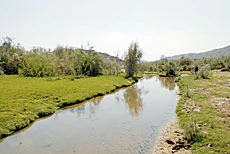
Two hundred and seventy kilometers southeast of Jeddah lies a little gem of an oasis for those who are tired of smoke-filled cities and never-ending shades of beige. Unlike the stereotypical oasis, it is strangely lacking in palm trees and there is not a camel in sight. Contented looking cows, however, graze on marshy ground covered with brilliant green grass. The cows and a lazy stream meandering through a silent valley make charming possibilities for the photographer. Framed artfully, the images could have been taken on a sunny day in any rich farming area. The egrets, earnestly following the casually strolling animals as assiduously as tax collectors gleaning pennies, give the lie to the scene being in northern climes.
Finches, chasing insects disturbed by the cows, boil into the air with a clatter of wings. squabbling loudly as they flash reds and yellows from their undersides. Elegant grey storks step daintily over pebbles in search of minnows in the shallow silver shoals of the stream. And observing everything are Egyptian vultures patrolling the sky and circling lazily over the valley on rising thermals.
All that plus the very persistent car-wash men with bucket, sand-impregnated cloth and an endless supply of hot water circling the car park on rising hope and sandals. After driving several hundred kilometers, they seem to understand that the first thing a tourist really needs to do on visiting an area of considerable ecological beauty is to have the car wet-sanded down to the bare metal for folding cash.
As with many ecological tourist sites in the Kingdom, part of the charm of the place is its isolation and the fact that there has been minimal development. The valley in which the verdant slash of vegetation lies is sustained by the hot springs and extends for many kilometers eastwards, though the surface water and the heavy vegetation disappear about ten kilometers east of the access point to the wadi.
The air is hot; water in the stream is hotter. Located as they are on the western coastal plain of the tectonic plate that forms the Arabian Peninsula, the wadi’s hot springs result from benign underground volcanic activity. The edge of a tectonic plate is almost invariably a source of seismic activity — not all of it violent but always with violence as a possibility. In the far north of the Kingdom along the edge of the Gulf of Aqaba, the seismic activity is close to the surface and much more visible. The volcanic cones of Jebel Abiyad near Madinah and the huge Wahbar crater provide evidence of the cataclysmic forces unleashed in Saudi Arabia in relatively recent geological history.
At Wadi Al-Lith, the activity is very much gentler — a stream heated to the temperature of bath water. The valley itself is floored with coarse sand near the stream and water-worn football-sized boulders towards its northern edge. Dense vegetation with occasional clearings makes for good camping areas although the soft sand in places is negotiable only with four wheel drive. The wadi seems to attract not only wildlife but many expatriate workers who take advantage of the free hot water to do their laundry, bathe and wash pickup trucks in the stream.
Largely undeveloped, the Wadi Al-Lith springs at Al-Ma’a Al-Har — a small village nestling under the southern cliffs of the wadi — are easy to access and the tarmac road that now gives easy access to the site, has its downside as well as its blessings. Just as the Wahbar crater suffered from the attentions of graffiti artists and litter bugs when the tarmac road was opened, so have the hot springs.
Shelters that provide picnic areas for families have been vandalized. Dumpsters have been placed at strategic spots around the car park and picnic areas close to canalized hot water springs. They stand in splendid and immaculate isolation, seeming to float on a sea of discarded food containers, drink cans and other detritus that surrounds them. Even the vultures ignore them.
Encouraging tourists to visit sites of natural beauty invariably changes the sites. Many of the changes can be handled sensitively — footpaths marked and reinforced to reduce wear on favorite rambles, for example. There is, however, no excuse for using what is a rarity in the Kingdom — a green and naturally grassy space — as a garbage dump. This is after all a place where the tourist authorities and the local municipal authority have provided sufficient dumpsters. Why are they not used?
Perhaps it is time to take matters a stage further; fence off the areas, introduce wardens with real powers and patrol the sites regularly. That band-aid solution by itself is not enough. It is hard to tell exactly why visitors throw garbage into a beauty spot. They even sit among their rubbish and that of others. It screams the questions: Can’t they see it? Aren’t they offended by it?
It took two generations for the “Keep Britain Tidy” campaign to develop from a legally enforceable anti-litter campaign to making tidiness almost instinctive in the public. It is a long road and a tiresome journey through schools, public education, public campaigns and legal enforcement.
However, the longest journey begins with a single step.
Begin!