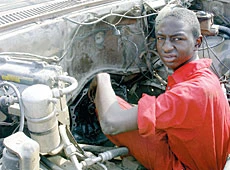
JEDDAH, 29 November 2006 — Many industrial workshops violate the rules and regulations of the Kingdom and international law that protect the rights of children. The owners of these workshops employ children under the age of 18 years to perform laborious jobs, operating machines and handling metals, paying them a meager SR600 a month or even less at times.
Children, especially of African and Asian origin, who agree to take up such work end up working for long periods of time exceeding 13 hours a day. They work in hazardous and unsafe environments without anything that ensures their safety during work. In addition, they have no social or health insurance.
A special Arab News tour of the industrial area and Bani Malik in the central and southern areas of Jeddah revealed an increase in the number of children working in these workshops.
The children said that their need for money is the reason why they perform dangerous tasks without supervision. They usually use the money to support their families that include 10 to 12 people. Sometimes the youngsters come from households in which the guardian is absent either because he’s ill or dead.
At the beginning of their work at car workshops, the mechanics do not ask the children to do mechanical work. They usually start by bringing drinks from a nearby coffeehouse.
Then the mechanics slowly assign the children much harder tasks such as undoing and tightening car engines and cutting iron.
While preparing this report, the Border Security Guard arrested three Yemeni children in Al-Toul who were smuggling qat into the Kingdom under very dangerous circumstances traveling almost 16 kilometers a day. These youngsters jeopardized their lives and safety to earn a meager 100 riyals ($30).
Hussain Al-Sharif, director of the National Society for Human Rights (NSHR) in Makkah, said that using children under the legal age to work in such laborious jobs in the Kingdom defies the UNICEF Convention on the Rights of Children.
He noted that the organization is against any violation of human rights. He added that in case there is available detailed information about these children’s work, official authorities including the Labor Ministry and the Ministry of Social Affairs must intervene to investigate the issue.
If the authorities succeed in collecting enough information, the workshop manager and child’s father should be penalized according to regulations that forbid underage children from working. He explained that the organization has not received any complaints yet from fathers or children working in workshops or metal shops.
Al-Sharif added that the ministries are the official authorities in charge of this issue. In case they fail to fulfill their obligations the NSHR could monitor the violations through reports directed to specific authorities. The organization is a supporting body and cannot undertake the authorities’ work.
With regard to helping children escape into a number of Arab countries, Al-Sharif confirmed that no meeting has been arranged between these countries in regard to the issue. Yet it’s a marginal topic discussed at a number of conferences the organization participated in without addressing the issue officially.
The World Trade Organization reported that there were 250 million children between the ages of five and fourteen working in developed countries and that they were deprived of proper education and health. Fifty percent of them, 120 million children, work full time whereas the other 130 million combine working with studying. Seventy percent of these children work in dangerous jobs.
Ehsan Al-Tayeb, manager of the Social Affairs Department in Makkah, believes that one of the main disadvantages for children working in such areas is their loss of childhood and the fact that they learn obscene language in addition to acquiring addictive habits such as smoking and drugs. He stressed the importance of making the fathers, who urge their children to work in return for low wages, aware of the fact that their children might lose their lives by doing that. He added that the Labor Office must work on stopping these violations and penalize these institutions or stop their activities for violating the labor system implemented in the Kingdom.
Talal Al-Nashry, a social worker at the King Fahd Hospital in Jeddah, said children were working because their families lack awareness. Their daily food needs force families to send children to work.
A source reassured that the Kingdom has succeeded in accomplishing its full responsibilities to develop and improve the lives of citizens. The country has proven its commitment to achieving the goals of providing the proper means of living, protection and development for children. But sometimes ill-mannered individuals working in different sectors violate the rules, therefore, they are penalized according to the system and legislations that existed years ago.
About six million foreigners, mostly Asians, work in Saudi Arabia. The Kingdom receives annually four million pilgrims and many overstay after the Haj season is over. They end up working in deserted locations away from supervision and target children for illegal employment such as selling in front of traffic lights and digging garbage bins and other hazardous jobs.
Recently, the security forces in Jeddah managed to arrest almost 40,000 illegal residents who came to the country with their children for Haj and never returned. Workshop managers and owners were motivated to take advantage of these situations to employ children with low wages.