
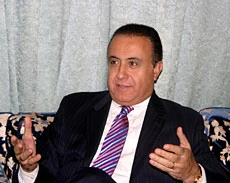
There is ongoing competition among financial companies to make attractive offers and woo the investor community. FinaVestment is one of them but with a difference. It is a company dedicated to excellence in offering reliable, cost-effective, high-value solutions, which meet the financial needs of investors through strategic approaches. It acts as a virtual consultant to develop new insights for tracking global assets and assists in the formation of tailored portfolios of personalized investment initiatives, and for realizing superior returns, says Habib F. Faris, managing director and founder of FinaVestment Ltd., London. In this exclusive interview with Arab News, Faris discusses a wide range of questions related to the investment sector.
Following are excerpts:
Q: Give us more details of FinaVestment?
A: Setting up FinaVestment Ltd. took years of careful preparation until it was officially established in the UK last year and started actual business this year. The timing was extremely important and we studied every angle of the business very closely with the main emphasis on serving investors in the Middle East with emphasis on the Gulf Cooperation Council (GCC), Saudi Arabia in particular.
Q: What made you take this initiative?
A: Well, we looked at the global market’s performance over the past few years and realized how a long-term profitable growth has become increasingly difficult to create. We also realized that there is a need for dedicated representation to investors and businesses to cope with the dynamic changes in global markets. Our initiative was to address these concerns and meet the challenges to ensure investors’ added value to their investments both locally and internationally.
Q: Where is the company based?
A: Our head office is on Park Lane in London with two other offices in Switzerland and Jordan. Our ambition is to open an office in the Kingdom and we are currently in the process of doing that.
Q: Competition being very strong in the Kingdom, how do you plan to meet it?
A: We plan to meet the competition by being different and offering different solutions. FinaVestment has developed a niche investment advisory organization with an investment culture but with local flavor. Here lies our differentiation strategy. By simply understanding what investors need, we can offer solutions by leveraging our strengths, capabilities, expertise, and market contacts. We feel, for example, that the local market in the Kingdom is under served in various ways and we plan to work diligently to address some of the existing issues.
Q: Which clients are you targeting?
A: The criteria for selecting clients include all those who really demand special attention to their assets. We listen, analyze, diagnose, and come up with suitable recommendations, and finally we follow-up and monitor the investment to ensure proper management and growth. We realize how important it is to maintain an ongoing dialogue with our clients and are committed to them and to their success.
Q: What about the response so far from the prospective investors?
A: Amazingly encouraging. The market opportunity is extensive, involving many potential lines of business and locations; this is due to FinaVestment management’s extensive local and international banking expertise. We show our clients that we care about them and we work for them to ensure best satisfaction to their investment goals and returns. In essence, they pay our salaries and we only can offer them best services and solutions. This honest and transparent approach had indeed created a most positive response.
Q: How is the response from Saudi investors?
A: As I mentioned the overall response has been encouraging and Saudi investors are equally enthusiastic to talk to us.
Q. The mood of investors in the Gulf is not good at present. Do you think it will affect your strategies in the region?
A: You are right. The mood is one of resignation and confusion. I have been covering this market for the past 30 years and have seen the ups and downs, and it is a “down syndrome” the region is experiencing these days. A wave of pessimistic views had led to lack of confidence as reflected in the drastic drop of the Tadawul All-Share Index and created a ripple effect in other major markets in the UAE, Qatar, Egypt, Jordan and others. So my answer is “yes.” Investors’ unsettled mood necessitated our constant review of strategy and approach in the region. Are we worried? Definitely not.
Q: You being an expert in stock markets, why do you say investors should not worry?
A: Because there is an underlying commodity in top-gear demand globally — oil. The Kingdom’s economy will resume its phenomenal growth in the coming years and there will be incremental demand for oil and its by-products as long as China, India and other fast expanding economies try to enhance their current growth trends. Therefore, the state of the Saudi economy is “safe” and doesn’t pose any problems and investors must rest assured of this. In this instance, the investors need not worry. The stock market is a different issue. It depends on the participants’ own diligence and evaluations in specific companies before they decide to invest one riyal.
Q: Do you think Saudi investors who had already burned their fingers will recover from the recent market collapse?
A: Investors must never time the market as even professional equity traders fail to read market trends. The problem in my view is one of controlled measures in trading and understanding the fundamentals of equity trading in the country and the region in general. Earlier this year, the stock market started to show signs of overheating and I presented cogent arguments to my clients to reduce their holdings. Only a few heeded my advice while many stuck with it. The real question is not whether investors will recover their trading losses, but why, or what, would cause such a recovery. Once I wrote that it is easy to buy stocks but hard to sell them. Investors feel somehow obliged to hold them, or fall in love with them, and will not accept a loss scenario. It is the psychology of the market. The other point, I believe, is the investors’ indulgence in trading without understanding the fundamentals of the companies they are investing in. For example, what they do, who are the management and what are their future plans, what’s the company’s valuation, etc.
Q: Will they recover their losses?
A: This is a subjective question to an objective answer. If an investor has realized losses, the damage is done, and the fingers are burned. Did he sell too soon? Should he have waited a bit longer? Remember what I said earlier, no one should time the market. However, if we learn from the recent history, specifically in October 1987’s Black Monday, the market dropped more than 30 percent on that miserable day but recovered in a few weeks. Those who opted out in panic were really hurt and those who rode the market recovered and in fact made more money. They recovered their losses because they were patient and had a longer-term investment vision.
Q: Any final word to those investors in the market today?
A: Just be careful and don’t build your investment strategy on hearsay or rumors. Stick to facts and fundamentals. Don’t allow yourself to fall into the debt trap. Build confidence in what you invest in by questioning company’s business and management.
I wish to address my final comment to those skeptics who need to reflect on what had evolved over the past few months and draw a useful lesson. The stock market environment is becoming highly disciplined to add credibility, accountability and adequate procedures to trade. The CMA (Capital Market Authority) is expending tremendous efforts in creating effective regulatory governance and they had done a great job. These are the ingredients for a healthy future trading environment.