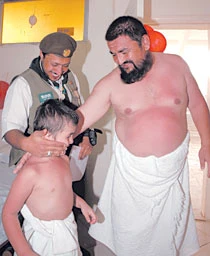
ARAFAT, 30 December 2006 — Tears started rolling on the cheeks of a Pakistani father yesterday when he was reunited with his lost five-year-old son Sami Abdul Salam at the missing persons area in Arafat.
“Sami had gone to the toilet with his mother, but he didn’t return,” said Wali Abdul Rahman, Sami’s father. “We panicked. Her mother started crying. Thank God that he is back with us due to the efforts and care of the officials at this center.”
Sami’s reunion with her family was in part thanks to the diligence of a pilgrim that noticed the child alone in the masses.
There were seven other kids waiting to be returned to their families at the center yesterday, including a four-year-old South Asian child who was too young to say his name or nationality. The children were being preoccupied with toys provided by the center as staffers waiting and hoped that the parents would eventually find themselves here.
Ibrahim, an eight-year-old Yemeni boy, was crying and trying to escape the center. He demanded to be reunited with his family. Unfortunately, he was unable to provide directions.
Much of the lost-and-found and information services are being provided by Saudi Boy Scouts — approximately 2,200 of them are mingling with over two million pilgrims, assisting when they can. By noon yesterday, about 40 children had been lost and then found, according to the personnel staffing the camp.
Nasser Al-Kilafi, director general of the Security and Safety Department at King Fahd University of Petroleum and Minerals, who has volunteered at the missing persons center in Arafat for the past 35 years, said most children end up being found.
The usual procedure now is to take pictures of the lost children as soon as they arrive and to upload them to a website — www.scouts.org.sa/haj27 — in hopes that Internet-savvy parents will check the site if their children go missing.
Children that are not claimed after the Standing of Arafat are relocated to Muzdalifah. “If they are not claimed by then we inform the concerned embassy,” Kilafi said.
It’s not only lost kids that end up at the center. The elderly come there to get information and guidance to relocate their camps. Staffers say the biggest problem is the language barrier confronted by many of the pilgrims seeking help.