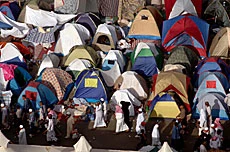
MINA, 1 January 2007 — The official figure for the number of pilgrims this year was reported to be 2.38 million, a six percent increase from last year, according to the government. But walking around the holy sites one can observe that many pilgrims are camping not in the large tents of Mina — the official accommodations provided by the Haj tour operators that pilgrims are required to go through — but in smaller portable tents, the kind you might see at any campsite.
While some of these pilgrims are probably here legally, many of them are surely undocumented, somehow having found a way to bypass official channels to reach the holy sites.
The cheap plastic tents, with their flimsy elastic rods and thin vinyl walls, are easily erected and packed away in a couple of minutes and therefore good for pilgrims who need to make and break camp wherever they find two square meters of space at Arafat, Muzdalifah, Mina or even next to the Haram.
Obviously having your own tent doesn’t automatically mean you’re an “illegal immigrant” to the holy city. Some pilgrims interviewed by Arab News say that they like the convenience of having their own portable shelter.
Mujibullah Afghani, an expatriate who lives in Jeddah, was seen camped in his own tent at Muzdalifah. He wouldn’t say if he had a Haj permit or if he had paid somebody to bring him in past the checkpoints. He said he had the tent because it was easy to carry and set up to take rests in between the rituals.
“I took it with me to the Haram when I came for the Ifada Tawaf (the obligatory circumambulation around the Kaaba),” he said. “I took a few hours’ rest in it near the bus depot in front of the mosque after I completed the Tawaf.”
Authorities have been urging pilgrims not to bring along unnecessary packs during their rituals because of the extreme overcrowding that typify parts of the Haj. Obviously Afghani didn’t heed the warning.
Ali Baba of Chad was camped out by the buses lined up near the Grand Mosque. He didn’t show a Haj permit when asked, but denied not being part of an official Haj tour group, which is obligatory.
He said he was simply resting before leaving for the Mina tent city where “legal” pilgrims are staying.
Saeed Al-Asi, an Egyptian who camped out nearby, was more honest.
“Most of these guys don’t have Haj permits,” he said, gesturing to his neighbors. “Most of them are foreigners living in Saudi Arabia and they didn’t get permits that allow them accommodations (provided by the Haj tour operators, known as tawafa organizations).”
Al-Asi wasn’t quite willing to admit his own status as an undocumented haji, though he seemed to make it clear when asked why he had the tent.
“With the cold weather these days and the cloudy atmosphere this is far better than sleeping on the pavement,” he said.
Abdullah Al-Saeedi, a shopkeeper on Makkah’s Sitteen Street, said the cold weather has caused many “squatting pilgrims” as he called them to come to him to buy portable shelter.
“Tents are the new umbrellas,” he said, referring to the fact that fewer pilgrims are buying umbrellas this year (used to shade themselves from the typically hot Saudi sun) because of the cool weather.