MINA, 2 January 2007 — As the Haj comes to a conclusion, national and ethnic differences among the pilgrims are apparent. The men don their caps in various styles and colors. White unsewn cloth is replaced with shalwar kameez, dishdasha and sarong. Wealthy pilgrims are wearing tailored woolen coats while the poorer pilgrims clutch tattered shawls. There is still an overall sense of community as the pilgrims are hurrying to complete the Haj rituals, but many also stop to purchase gifts for loved ones. The pilgrims are still focused on spiritual preoccupations.
In Mina, the streets are packed with pilgrims rushing to and fro.
Everywhere one looks it is a colorful sea of people. The sheer numbers of pilgrims overwhelm everything in their path. They engulf the motorized vehicles and march up and around the Jamrat Bridge. They are an oncoming force on all routes to Makkah. Traffic police and security personnel must shout at top volume to be heard over the hubbub of the crowds. For the officers, directing the human traffic in the area is a physically demanding task. “Please don’t push,” the officers beg.
“Please keep moving,” the officers implore. “Please be careful,” the officers urge. The pilgrims, caught up in their own immediate surroundings, too often don’t understand why the officers are so unwilling to let them sit down on the pavement or why the police refuse to allow them to turn against the flow on certain streets.
It is a pity that every pilgrim coming to Mina could not be given a bird’s-eye view of the area. Perhaps then they would understand the staggering security and logistics nightmare that the authorities are trying to keep under control. The helicopters circling the holy sites from above are constantly reporting to the ground commanders about areas of congestion at the holy sites.
Security forces manning the massive bridge are immediately alerted to the problems and move in to remedy the situation, perhaps by restricting the flow of pilgrims or vehicles to the area, or clearing out squatters and their luggage or directing sidewalk vendors to less obstructed locations.
There is no time for explanation or arguing. With every crisis averted, another one is already developing. For the Kingdom’s service and security personnel the Haj is an annual marathon.
In the past, sometimes I would get very nervous with the security personnel at Haj. Their instructions could seem pointless and inconvenient. Then on Sunday, I had the opportunity to join 19 other journalists in a helicopter tour of the holy sites. Packed into the passenger benches of two massive choppers, we clamped earmuffs to our heads to drown out the rotor and engine noise and hung on to overhead straps for dear life.
It took just a few minutes for us to realize that the experienced Civil Defense pilots were taking us on a slow gentle ride, designed to allow us to view the area, snap our photos and keep our wits about us.
One door of the helicopter was open from the top, enabling everyone to take turns putting camera lenses out for a clear unobstructed capture of the scene below.
From above, the pilgrimage looks very different. The hubbub is gone and the scene below is white, black and shades of gray. At Mina, the tents stretch out in waves with Al-Kuwaiti Mosque floating in the center of the swells. King Abdul Aziz Bridge is a slash through tent city. The Jamrat Bridge is an imposing structure, lined with tower cranes just waiting to start working again.
The pilgrims are mere dots creeping slowly up, down and around the bridge. They cluster tightly around the three Jamrat, which are walls jutting up from the bridge’s surface. As the pilgrims come forward on the bridge they pass the first wall, Jamrat Al-Ula, then they pass the second wall, Jamrat Al-Wusta, and finally there is Jamrat Al-Aqaba. Then the pilgrims move off through several different lanes and away from the bridge.
We flew over the hills that surround Mina, with the highway to Makkah a black snake, pushing through the tunnels in the mountains beneath the helicopter. The road was remarkably unobstructed and traffic was moving well toward Makkah. Our group included journalists from all over the world, both men and women, including Arifa Akbar, a news reporter with UK’s The Independent newspaper, award-winning Saudi photographer Susan Baaghil and TV producer Azlan Bin Asri from Singapore’s Channel News Asia.
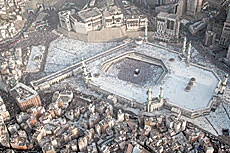
Suddenly there was a collective gasp. The Holy Haram came into view dead ahead. Cameras began snapping and telephoto lenses were set long to get the closest shot.
Once the requisite images were in hand, everyone needed a photo of himself or herself with the pilgrims performing tawaf (circumambulation) in the background. As the earmuffs cut out all sound, communication was by means of hand signals, with all the journalists shifting left and right to enable everyone to have an equal chance to take photographs and get a direct look at the majestic scene below.
The helicopter tour has given me a new appreciation for the efforts of the authorities. Hearing that nearly three million pilgrims came for Haj is one thing. Looking down on those millions from above provides a different perspective on the event and what is required to bring it to a successful conclusion.
The numerous requests from other media to view the photographs taken during the helicopter ride and the thoughts and queries they expressed after seeing these pictures, shows that more such opportunities would give a considerable boost to the authorities’ efforts to highlight the huge effort required in hosting the Haj annually.
After watching the Haj transform from a sea of white into a journey of individuals, it was somehow comforting to have the chance to look at it once again as a joining of Muslims. From the helicopter, the pilgrims individually appeared as insignificant specks on the ground below. Taken together, those specks combined to be an impressive ribbon of the faithful, tied together by belief in Allah, obedience to His commands and the emulation of our beloved Prophet (peace be upon him).