TAIF, 11 January 2007 — Make a triangle with lines connecting the highland city of Al-Taif, Abha, and Riyadh. Within these boundaries can be found a dry, sparsely populated flatland roughly bordered by three main highways connecting these major cities.
Somewhere between Wadi Al-Dawasser, in the central part of this triangle, and the low mountain range that runs parallel to the Red Sea coast, is the Renya Desert.
This arid inland zone has become a graveyard of lost migrants, mainly of Yemeni and African origins, traveling off the beaten path in an attempt to skirt migration checkpoints set up on major routes, especially highways 10 (Abha-Riyadh), 40 (Taif-Riyadh) and 15 (Abha-Taif) — the three sides of this arid triangle. “Most of the bodies found were people trying to travel between cities in the Kingdom and avoiding authorities,” said Col. Abdullah Al-Zahrani, the police chief of Renya, the small inland city east of Taif that has become ground zero for corpse retrieval.
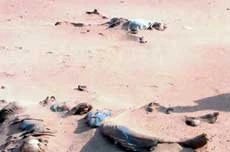
“They underestimated the risk of such journey, lost their way inside the desert and died as a result.” Authorities believe that most of the 49 bodies discovered in this region since early 2005 are illegal migrants, though they haven’t ruled out the possibility that some of them were dumped in the area as a result of foul play. Stories abound of migrants who have been saved at the last minute from a sure death from dehydration, or even nighttime hypothermia. Many locals have stories of happening upon decomposed and air-dried corpses as they were out retrieving a stray camel or out on a picnic. They describe it as a tough area that is very difficult even for the expert people who know their location inside the desert.
The forensic department in Taif says that all the bodies that they found in the desert were decomposed and some of them were skeletons. They said that most of them died during summer time.
People who were saved from Renya told police that they fell victim to smugglers who promised to show them a route away from police eyes. In the middle of the road, they abandoned them and left them to die. Some of the people who were saved said that they thought it was easy to cross the desert and instead they lost their way. A Saudi man from Renya, Talal Al-Otaibi, said that there was a strong rumor that a serial killer was killing people and dumping their bodies in the desert. “There were stories of bodies found with their hands tied behind their backs,” he said. “Many thought that a serial killer was murdering overstayer victims after robbing them. On many occasions police calmed down the residents saying that it was not true. But many bodies found showed indications that they did not die from natural causes.”
Muhammad Al-Farraj, resident, told Arab News that his children discovered a decomposed body while playing near a mountain. “My kids told me about a human skeleton found between the mountains,” said Al-Farraj. “When I went there, I saw the body of a man covered with a sheet. He might have died while asleep and it might have happened last winter. I notified police who arrived and took care of the body.” Abdul Kader Muhammad, a Bangladeshi worker in the province, said that many people are afraid to leave their homes after the news of bodies in the desert. “Once, police asked us to go with them to finish a job,” said Muhammad. “They took us to a place between the mountains where two bodies were discovered. We had to carry these bodies inside the police car to a local hospital. These bodies were covered with blood.”