
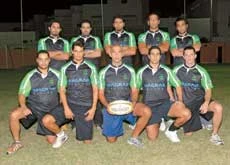
TO many, both inside and outside the Kingdom, the concept of a Saudi rugby team seems a contradiction in terms. However unlikely the idea, the fact is that the Saudi Scorpions — a genuine all-Saudi rugby team — acquitted themselves with distinction at the prestigious Dubai International Rugby Sevens in early December and, as a result, surprised many who met and played them.
Ahmed El-Maghraby was extremely proud of their performance — especially as it was their first visit to the Dubai Sevens. “Many of us did not know what to expect and underestimated our ability, commitment, and heart vis-à-vis the competition,” he said. “We took many positives from the experience and look forward to a better showing next year.”
Rugby has never achieved the global saturation of soccer but what it lacks in popularity, it more than makes up for with passion, both on and off the field and in its supporters’ dedication. Rugby is at first hard to comprehend. It boils down to two teams of very fit individuals committing outrageous acts of violence upon each other while in pursuit of a ball that bounces unpredictably — and all this without body armor.
“It’s like going into a battle, a war zone,” Mohamed Alireza confirmed. “You depend on every single member of the team to back you up, to be there for you and in return, you’re there for them.” In the violent and very serious situation of a hard-fought match, being able to depend on your teammates is vital. “Rugby creates a strong bond between players — more so perhaps than other team sports.”
Therein is a major attraction for the players; time and again in conversation with the Scorpions, the camaraderie and strong personal friendships that exist between the players were all attributed to the forging of trust on the pitch. “The bonds and camaraderie is incredible” chimed in Haytham Zahid. “I have not felt as alive in ten years as I did when I was on the field with my teammates.” He said that the feeling of being part of something that was greater than himself, relying on his teammates and being relied on in return, made, “the whole experience amazing.”
That element of camaraderie was echoed by David Skidmore, the Chairman of the Arabian Gulf Rugby Football Union (AGRFU). He said that successful rugby relied on players working together as a team. “You very quickly learn the importance of team work, discipline and camaraderie.”
In another contradiction, the violence of the game has a calming effect on the players. The frustrations of modern life create tensions — in extreme cases, hypertension and illness. “Playing rugby is great when you need to let steam off at the end of the day,” said Mohamed Khashoggi. “For me, to get out there and play some good contact rugby takes out a lot of aggression.”
Mohamed Alireza said that the game enabled the player to find his own limits. Out there somewhere, there is always someone who is better or bigger than you. “It feels great to tackle someone bigger or faster than you; it humbles you as well,” he said. “You win, you lose — but you win and you lose together.”
“There can actually be more pleasure in making a good assist or tackle than in scoring a try,” said Salman Alireza who handles the team’s media affairs. “In many other sports, importance is attached to how the goals are scored — but in rugby every facet of the game is looked at, from making a tackle, to setting up a try, to scoring a drop kick or penalty. Team members and supporters get energized when any of these things happen, and that creates a great atmosphere.” Hamza Zahid, the team captain, agreed and broadened the perspective: “That is the special thing about rugby supporters; for them it’s not all about how many times you have scored — it’s about how you have played as a team.”
The Scorpions were modest about their achievement in Dubai. “Just being there was quite an achievement,” said Zahid. “The Dubai Sevens is one of the biggest sporting events in the Middle East, rivaling the F1 in Bahrain, and the Dubai World Cup for horseracing; over 70,000 spectators attended over 3 days. We had high expectations; but when all is said and done, to get as far as we did was an achievement in itself.”
They would not have achieved that without unstinting help from the Jeddah Rugby Club (JRC), a team of expatriate players who also made a good impression at the tournament. The Scorpions were grateful for JRC’s support and by playing both with and against them, the experience of hard contact rugby.
Jacob Ball, current chairman of the JRC said that the club was now in a reforming phase. New life is being breathed into the game through expatriate players and, “Saudi nationals who keep showing up to play and work hard at playing better rugby.” Ball was optimistic that a rugby club would form from what was once an exclusively expatriate club that never thought a Saudi would be interested in rugby. “JRC is now a club aware that the largest pool of potential talent lies in Saudi youth — more than half the Saudi population — that chooses to take up the sport and the discipline that comes with it,” he said. He sees hope for rugby in Saudi but it will rely on the eagerness of both the young to play and the experienced to teach. Ball sees young locals picking up the ball with the spirit and enthusiasm that the expat community has shown for years. “The expats need the Saudi players and the Saudi players need the expats. If we play this right, all will benefit, and I feel that we are just beginning to see the potential for the sport’s growth here.”
As rugby in the Kingdom is definitely a minority sport, the Scorpions — as well as the JRC — are affected by the lack of competitive matches, a dearth of team members and the services of a specialist coach. “Coaching yourself and others while being a player on the team makes it hard to pull away and see the bigger picture,” said Salman Alireza. “A full-time coach would see things on a larger scale — make it more obvious what skills we need to work on.” He said that the team had a good understanding of the basics, but the finer points of attack and defense needed work. “Coaching is critical — especially if we add new players to the team,” he said.
The squad’s lack of depth in Dubai took its toll. The majority of the team played in every game; losing Ahmed El-Maghraby, one of their most able and speedy players because of an injured shoulder in the first match was a blow. “By the second day that had had a big impact on our general well-being,” said Salman Alireza. “Not so much injured but bruised and extremely stiff. That had a major effect on the results.”
All the team agreed there were many benefits. The consensus was that players learned a lot about how to treat people, and how people treat and respect you. “There are some very special qualities about rugby that I have taken into my own life,” said Salman Alireza.
“This was definitely a learning experience,” said Hamza Zahid. “We will be going back next year with a bigger squad, improved fitness, a full time coach, and some strategies in hand; I think we have a chance of going far.”
Skidmore concurred. “I think rugby has a lot to offer Saudi Arabia, in terms of youth participating in an exciting sport. From what I have seen, there is a nucleus of a competitive national team that I would like to see compete in the 2010 Asia games in China and it would be great to see some players on the Arabian Gulf representative team.”
To find out more about rugby in Saudi Arabia visit:
www.jeddahrugby.com.