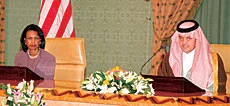
RIYADH, 17 January 2007 — Foreign Minister Prince Saud Al-Faisal said at a joint press conference with US Secretary of State Condoleezza Rice yesterday that the Kingdom “blessed” the goals and objectives of the new US strategy in Iraq which were announced by President George W. Bush last week.
“We agree with the American president on the need for a new strategy in Iraq which has clear agendas that respond to recent developments and are practical on the ground,” the foreign minister said.
He noted that the Kingdom welcomed many elements of the new strategy, which aims at restoring security in Iraq by dealing, without ethnic distinction, with all sources of violence and terrorism.
He also said that the strategy aimed at a fair distribution of Iraqi wealth as well as at unifying Iraq by encouraging participation by all Iraqi ethnic groups in the political process.
“We hope that some small changes will be made to the constitution in order to guarantee the participation of all groups in the political process,” he said. Prince Saud said that another important point in the new US strategy in Iraq with which the Kingdom agreed was the noninterference in Iraqi internal affairs, the respect for Iraqi sovereignty and the unification of all its lands.
“We hope that the US president’s plan will find a way for these goals to be achieved,” he said. “We also hope that the plan continues to support the upcoming National Iraqi Conference based on efforts by the Arab League,” he added, pointing out that Iraqi problems had an impact on the security of the region and the world.
Prince Saud said that his discussions with Rice also included the situation in the Palestinian territories. “We talked about efforts for reviving the peace plan and establishing a fair and comprehensive peace in addition to the creation of a Palestinian state side by side with Israel according to President Bush’s vision and international treaties.”
He said the Kingdom welcomed the US administration’s commitment to accelerate peace efforts and establish a Palestinian state. Rice noted that her talks with the Saudis were about how the Kingdom could support the development of a stable and unified Iraq. She described the Kingdom as “an extremely important regional power,” lauding Riyadh’s efforts for national reconciliation and peace in Iraq. Prince Saud said that he and Rice had discussed the danger of nuclear weapons in the region, adding that both sides agreed that differences should be solved by diplomatic efforts.
Asked if she had read the letter submitted to Custodian of the Two Holy Mosques King Abdullah by an Iranian official this week and whether Iran was seeking the Kingdom’s mediation in the dispute between the US and Iran, Rice said that that the conflict was not with the US but with the international community.
“There is no need for mediation between the US and Iran,” she said. “There is a resolution in the Security Council that sets out the demands on Iran to stop enrichment so that negotiations can begin. That is not the position of the United States. Iran needs to respond to the wishes of the international community.”
Prince Saud ruled out any mediation between the US and Iran by the Kingdom. “Our relations with the United States are long standing. Iran is a neighbor of ours so obviously we hope to avoid any problems.”
Rice noted that during her talks with Abbas and Olmert, she saw that there were issues which had not been talked about for six years. The idea of nonofficial talks between Palestinians and Israelis was welcomed by both parties, she said. Rice said that the United States did not exclude Syria from peace talks, but that Syria excluded itself because of its actions.