GAZA CITY, 20 January 2007 — President Mahmoud Abbas said yesterday he’ll go for early Palestinian elections if the latest round of coalition talks with Hamas fails in Damascus today.
Abbas also said it’s time for Hamas to make up its mind whether it wants to establish a government acceptable to the West, by moderating its platform and sharing power with his Fatah party.
Hamas has resisted demands by the international community that it recognize Israel, renounce violence and accept existing peace talks. However, a foreign aid boycott would continue, unless a new Palestinian government agrees on a moderate platform.
Today, Abbas is set to meet with Hamas’ supreme leader, Khaled Meshaal, for crucial talks on whether Hamas will accept the terms of a coalition with Fatah.
Abbas suggested he wouldn’t wait much longer for a decision by Hamas. He had said last month he would call early legislative and presidential elections if coalition talks fail.
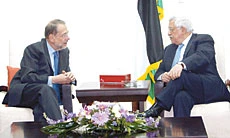
“We say either a (unity) government or elections,” he said after a meeting with EU foreign policy chief Javier Solana. “And election doesn’t mean we want to throw Hamas into the sea. Hamas has been elected and can be elected again. Welcome, then. But we are living in a crisis, and we all saw that the only solution is the government. But if the government is not formed, we have to ask the people.”
Hamas has accused Abbas of trying to topple its government by calling elections.
Abbas also said the talks have run their course. “It is very clear how to get a national unity government than can break the siege,” he said, referring to the aid boycott. “We need no more details.”
Meanwhile, tentative talks between Israel and the Palestinians aimed at restarting the stalled peace process could begin next month, US Secretary of State Condoleezza Rice said during meetings in Europe to rally support from British and German leaders.
A three-way meeting with Israeli Prime Minister Ehud Olmert and President Abbas would likely take place in the Middle East in the first half of February, but would not constitute formal negotiations, Rice said Thursday.
Winding up a weeklong tour of the Middle East and Europe, Rice briefed German Chancellor Angela Merkel in Berlin and said US, German and other diplomats would convene a Middle East strategy session early next month in Washington.
Rice later held talks with British Prime Minister Tony Blair and Foreign Secretary Margaret Beckett. Blair has made the task of helping revive peace talks a key goal of his final months in office. He toured the region in December.
“We do believe there is a willingness on the Israeli side and certainly on the part of President Abbas to move forward in what admittedly are difficult circumstances,” Blair’s official spokesman said yesterday.
Blair believed engagement on the part of the United States was helping to make progress, his spokesman said, and hoped the decision by Israel yesterday to release $100 million in frozen tax funds to Abbas was a crucial step.
Rice, who flew out of London yesterday, said her planned discussions with Olmert and Abbas would form a peacemaking summit, ahead of later talks to tackle the toughest issues.
“We’re not yet at the point where I think we can determine what we would do about formal negotiations, when and if” they can occur, Rice said. “It’s really a time to try to get the parties into more of a confidence-building phase and we’ll see what comes after that.”
Both leaders have suffered blows to their authority in the last year: Olmert by last summer’s disappointing war in Lebanon and allegations of political corruption in his ranks; Abbas by his yearlong internal power struggle with Hamas.
Blair has pledged Britain would provide assistance to Abbas and spoke with Rice about ways in which he could best help the Palestinian president, his spokesman said.
Rice acknowledged that the requirements of the 2003 step-by-step plan for Palestinian statehood, known as the road map, had become something of an obstacle in restarting talks between the two sides, but she said it remains the guideline.
In another important development, Israel has put on hold plans to build a new settlement on a former army base in the occupied West Bank, an Israeli security source said yesterday.
Israel drew criticism when it announced last month a plan to turn the former base at Maskiot, in the Jordan Valley, into a permanent housing complex for Jewish settlers.
“A few weeks ago the defense minister ordered a freeze on the plans regarding Maskiot in order to conduct a deeper investigation,” the source said.
— With input from agencies