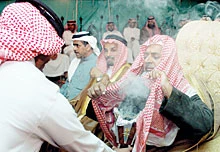
JEDDAH, 24 January 2007 — A study from the National Cheng Kung University in Tainan, Taiwan, suggests that burning incense considerably increases the risk of people contracting respiratory problems, even lung cancer.
The study has particular relevance to Saudi Arabia due to the common habit of using “bakhour” (incense) to fill households with the rustic aroma of oud, a type of oily wood, the burning of which increases the particulate matter of the air, creating indoor air pollution that can be particularly harmful to young children and the elderly.
Dr. Sayed Oraby, a consultant pulmonologist at Jeddah’s Dr. Erfan & Bagedo Hospital, told Arab News that he agreed with the study’s conclusions.
“The smoke that comes out of burning incense is similar to vehicular exhaust, which is a mixture of chemicals, such as carbon monoxide.
“It provokes the bronchi (airways) in the lungs, especially in people who suffer from asthma,” he said.
He stressed that the danger increases with the long-term exposure to incense smoke.
Dr. Ta Chang Lin, who conducted the study, compared the smoke of incense with the smoke of cars and found out a high concentration of polycyclic aromatic hydrocarbons (PAH), which are chemicals that are released from burned substances.
When incense is burned, people nearby inhale lung-aggravating tiny particles of ash, as well as carbon monoxide, an odorless gas that in high concentration can cause death.
Research, such as the one carried out by Cheng Kung, shows that burning incense produces many of the same dangerous byproducts found in cigarette smoke.
It is recommended that incense be burned in adequately-ventilated areas, preferably outdoors or with doors and windows open, or in rooms with a lot of space for the smoke to disperse.