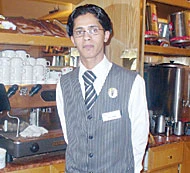
RIYADH — In many countries, the idea of a citizen working as a waiter is not a big deal. In Saudi Arabia, however, the concept of a Saudi doing a job most commonly associated with imported guest workers is still a novelty. But 21-year-old Abdul Rahman Al-Khabrani says he has no problem being a hard-working waiter at a five-star hotel in Riyadh.
“I’m proud that I work,” he said, adding that it doesn’t bother him that some of his countrymen and women look down on him as a Saudi earning an honest riyal.
In a country where imported workers often do low-wage jobs, the idea of a Saudi playing the role more commonly associated with a South Asian is foreign in itself. Their fellow citizens often look at Saudis who do such jobs with derision.
But Al-Khabrani says he feels a bit like a pioneer in a new world where Saudi Arabia is trying to reduce its dependence on foreign labor under its Saudization policy.
“I applied for this job through one of my friends nine months ago,” he said. “I didn’t have any experience working in a hotel, but I trained for two weeks and now work without supervision.”
Al-Khabrani says that Saudis who look down on other Saudis doing this type of jobs should get over themselves and recognize the importance of respecting Saudis willing to do this work. Instead, says Al-Khabrani, Saudis should feel more ashamed about the high unemployment of Saudi men.
“This job did not stop me from planning my future,” he said. “After I was employed here I asked for a girl’s hand in marriage and my wedding will be held very soon. My family is very supportive. They knew that people would look down on me because of my work, but they have stood by me all the way. My father told me to ignore all those who try to put me down. I met some people who tried to encourage me to leave the job.”
Al-Khabrani said he has managed to form good relationships with the doctors, managers and other upper class Saudis. They sometimes ask about him when he is not there. He said the people least likely to judge him are the ones who earn higher incomes — they respect hard work, he says, because that’s how they got to their positions. His unemployed friends, on the other hand, have pressured him to quit.
“I remember one day when I met (Secretary-General of the Supreme Commission for Tourism) Prince Sultan ibn Salman. He thanked the hotel administration for Saudizing the jobs at the hotel.”
Al-Khabrani said that Saudis have no choice but to get off their high horses about blue-collar work because this work ethic is vital to the development of the country.
“It is just a matter of time before people start accepting Saudis in this type of work,” he said. “People looked down on Saudis driving limousine cars and now we see many Saudis working there and people accepting them. People objected to Saudis working in the fruit markets saying that it was a job for foreigners.
“Now we see many Saudis working in the fruit market and people accepting them. I guess it is just a matter of time before people accept me working as a waiter.”
Like a typical worker with aspirations, Al-Khabrani said he hopes to be promoted and through patience and hard work achieve a better position at the hotel. He is taking English-language courses in his spare time to pick up that important skill.
He said he feels confident that he’ll advance because he has the skills needed to work in the hotel industry.
“Not many Saudis are experts in customer service,” he said. “Being a waiter at a five-star hotel means being patient and being a people-person who can handle angry customers. Most of all, you have to recognize that the customer is vital to the hotel’s financial health and profitability. Not every Saudi these days seems to understand this.”