DUBAI, 7 February 2007 — The appointment of eight women to the Federal National Council (FNC) of the United Arab Emirates (UAE) was hailed as a step that would enrich the country’s democratic process.
In an unprecedented move, UAE President Sheikh Khalifa ibn Zayed Al-Nahayan issued on Sunday a decree naming the eight women to the UAE parliament. The president was fulfilling his promise, which he made to the nation in a speech in 2005, to empower women.
The appointments bring to nine the number of women representatives in the legislative body. In the first ever elections to FNC held in December, Amal Al-Qubaisi won a seat from Abu Dhabi.
The women members now constitute 22.2 percent of the FNC, a figure that is higher than some countries in Europe. The women are among the 20 nominated members of the 40-member house. The FNC is an advisory body, formed under the Provisional Constitution of the UAE in 1971 as a permanent component of the country’s governance structure.
The December elections were unprecedented in more than one way, for it was the first time that women were eligible for inclusion in the country’s consultative council. More than 1,000 women were among the 6,595 members of the Electoral College; all were eligible to stand for election as well as to vote.
Speaking to Arab News, Maisa Ghadeer, one of the nominated members, said that she was honored to be in such a position.
Ghadeer had unsuccessfully run in the FNC polls in December. But she had got the highest number of votes amongst the women who contested the election.
The 32-year-old works as an assistant PR manager at Sama Dubai, one of the companies owned by Dubai Holdings.
The mother of a seven-year-old holds a degree in Arabic literature from UAE University and is currently studying for her Masters in the same field. Ghadeer also writes a daily column in Al-Bayan newspaper in which she discusses local issues.
Ghadeer told Arab News that she would not focus on women’s issues alone during her tenure, as Emirati women do not feel that there is a difference between them and men. “All issues that affect men affect women, too. Yes there may be certain issues that may pertain to women which we as women may pay particular attention to, but in general we will focus on all issues that affect the citizens regardless of their gender,” she said.
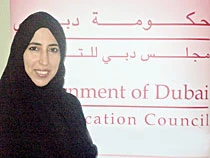
Another nominee, Fatima Al-Marri, said that she would focus on education during her time in the council. Al-Marri, who works as an educational adviser at the Dubai Educational Council, was ecstatic when she heard of her nomination. “Of course, I wished to be part of the whole political process but the news came out of the blue for me,” she said.
Al-Marri, who is a graduate of UAE University, has worked in the educational field for more than 15 years. She believes that education is the key to progress.
“We in the UAE need to upgrade our educational system so that we can be up to the challenges that modernity presents. We need to have a system that will prepare our youth for all these changes but at the same time teach them to respect their religion and heritage,” she said.
The other women nominees are Fatima Al-Mazrouei, Najla Al-Awadhi, Ayesha Al-Roumi, Nidhal Al-Tunaiji, Aliaa Al-Suwaidi and Ruwaia Al-Samahi.