MAKKAH, 11 February 2007 — The problem of elderly homeless people living on the sidewalks of Makkah seems to be a growing phenomena. In the past, it was rare for residents of the holy city to see the elderly living their last days on the street. However, this social taboo has now become something extremely widespread.
It is a common perception among the people of Makkah that the city’s sidewalks are home to sick, elderly people who feel they have been ignored by the Social Affairs Ministry. Their concern is shared by city residents who feel that the ministry is not doing enough to bring a solution to the problem.
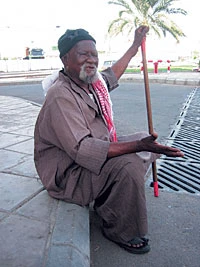
Muhammad Kabeer, 80, is a chain smoker. He has an extremely short temper and lives on a sidewalk near the old fruit market in the Jarwal suburb. People in the vicinity say that Kabeer, when not sleeping, is always angry and has a habit of complaining and continuously smoking.
When this journalist approached Kabeer, the old man went into a fit. He began cursing me and threatened to hit me with his walking stick if I did not go away. I tried to convince him that I wanted to help him by publicizing his plight. Nevertheless, the old man continued to insist he would physically hurt me if I did not stop talking to him. “Journalists never tell the truth. A journalist interviewed me a couple of years ago and wrote a load of lies,” said Kabeer in the duration of his outburst.
After some persistence, Kabeer felt comfortable and agreed to speak to Arab News hoping that a municipal official would read about him and help him. The old man said he has been living on the streets of Makkah after the majority of his family members died. Only a few are alive.
Kabeer says he cannot afford to rent a home and therefore sleeps on the streets. He used to live in a room for which he paid SR400 a month. The room was in a bad state and his landlord asked him to either repair it or leave. Kabeer finally left and has since lived on the streets.
The 80-year-old smokes 60 cigarettes a day and suffers chest pains. He is in a terrible shape. A couple of years ago, he lost sight in his left eye.
Kabeer hates people; he believes they are unsympathetic and can easily get irritated over the most trivial of things.
By profession, Kabeer is a chef but stopped cooking after suffering eyesight problems. “The burning smoke from wood and steam are behind my eye problems. I stopped cooking fearing that I might lose the sight in my other eye,” he said.
“People have no heart. They take advantage of my condition. I was once robbed when I was walking in the street. The thief took my wallet and 10 riyals. I was in a taxi three months ago when the driver took advantage of my weak condition and robbed SR200 and my national ID card. I went to the Civil Department to get a replacement card and the official shouted at me because I had lost it more than once. He refused to issue a new one,” he added.
Kabeer now wanders the streets of Makkah carrying a copy of an old card that he uses for identification purposes. His experience of people has made him bitter and so he shuns them. “All I want is to live a dignified life in a suitable home or room for the remaining days of my life. Is this too much to ask?” he said.
Dr. Rajab Al-Bersali, head of the Psychiatric Department at the King Abdul Aziz Hospital in Makkah, feels Kabeer is suffering from a split personality disorder.
“Such people tend to isolate themselves from other people and they end up neglecting the way they look. Most of the time they are angry and behave violently toward others,” said Al-Bersali.
“The man is living in a terrible condition and could harm himself and members of the public. I think the authorities need to help him and provide him with proper care,” he said.