
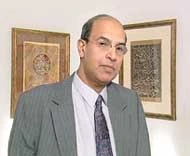
CALLIGRAPHY exhibits filled the Rochan Gallery in Jeddah during a 10-day exhibition featuring the work of British calligrapher Sayed Tajammul Hussain that ended Monday, Feb. 5.
Thirty-one calligraphic pieces of art depicting verses of the Holy Qur’an were on display at the exhibition. The calligraphy varied between Al-Thuluth, Kufic and Andalusi scripts and the various exhibits had a range of colors and styles to suit the different tastes of visitors. Some were painted on handmade rice paper and most were embossed with gold leaves. All of them were for sale except for one piece.
Not only is Hussain a calligrapher but also a chartered accountant — a profession unrelated to art and calligraphy. Hussain started his practical artistic life as a talented painter. His love for Arabian calligraphy made him learn the art when he studied the Thuluth and Kufic scripts under leading Iranian calligrapher Hossain Vagehfi when he visited London where Hussain lives.
Keeper Emeritus of the British Museum in London, the late Martin Lings gave Hussain knowledge on the sacred art of the illumination of the Holy Qur’an. At the age of 23 in 1976, Hussain displayed his calligraphic paintings of Qur’anic manuscripts in celebration of the 1400th Hijri year.
“My father’s friend, who was a calligraphist, encouraged me to participate in the exhibition which illustrated my talent in calligraphy and was a turning point in my calligraphy work,” he said.
Hussain has designed logos for Qatar Airways, Egypt Air and Pakistani International Airlines using the Kufic Arabic calligraphy.
His work can now be seen across the world at the Ashmolean Museum, the British Museum, St. Mungo’s Museum, the Museum of Modern Art in Glasgow, the UK Prime Minister’s Official Residence, the National Library in Lahore, and the National Museum of Scotland in Edinburgh.