
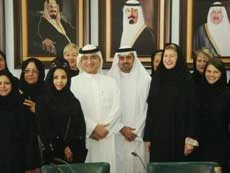
JEDDAH, 19 February 2007 — A 14-member Australian group of professional women has expressed interests in further strengthening relations with the Kingdom. The first such Australian delegation to visit Saudi Arabia, the members met with a group of Saudi businessmen and businesswomen at the Jeddah Chamber of Commerce and Industry (JCCI) yesterday to enhance investment opportunities and build relationships between their respective countries.
“I’m interested in building bridges,” said Fina Hill, head of the delegation and executive officer of the Australia-Arab Chamber of Commerce and Industry.
“Unfortunately the concentration on trade has in fact been superficial. It’s unfortunate to use negative words but as women we consider ourselves able and permitted because of our gender to go deeper into Saudi culture. We don’t wish to discriminate against men in the Kingdom, but as a group of women we would like to institute a Saudi Arabia-Australia women’s friendship group within the JCCI,” she underscored.
A fluent Arabic speaker who commonly uses the phrase ‘insha’Allah’ (meaning Allah wills), Hill owns Almanar Consultancy (www.almanarconsultancy.com) that promotes Australian and Arab relations. Her clients range from large corporations to family-based businesses and entrepreneurs.
“I worked with Arab-Muslim communities in Australia because, in my opinion, most Australians don’t understand the culture of this part of the world. In our schools there’s little exposure to this huge area of the world,” she said.
Hill recently established the Islamic World Discovery Project (IWDP) — an Australian education initiative that develops curriculum resources about the history, philosophy, and contemporary life within the Arab and Islamic world.
“The IWDP is grateful for support from clients and others in the Arab and Muslim countries. The project is designed to expose Australian students and teachers to more information about the Arab and Islamic world in terms of case studies. I believe it’s not appropriate to teach purely about the religion but we can incorporate religious aspects into the project,” Hill said.
Anna McPhee, director of the Australia-based Equal Opportunities for Women in the Workplace Agency, said that for approximately the past 20 years, the Australian government has been focusing on women participation in the workplace and has worked toward improving their business opportunities. Today, nearly 50 percent of the Australian workforce is female.
“We work with employers to improve women’s participation by providing awareness of the advantages of enabling women to achieve their full potential. Employers are reaping the benefits through increased employee effectiveness, they are attracting and retaining the best talent, improving morale and increasing consumer and market responsiveness.” McPhee said.
She said that if women were not given further opportunities to advance in the workplace and achieve their greatest potential, their productivity and loyalty would not be maintained. “I imagine that the Kingdom needs productivity to advance economically,” she said. “In all communities you have to work with the culture and what works for women. Not every woman is the same and not every workplace is the same, of course. But we’re more than happy to share and to provide the case study material and information we’re doing to advance women,” she added.
By bringing a diverse group of women of various professional backgrounds, Hill aims to enhance the group’s experiences. “When we go back to Australia we’ll be taking lots of stories not just one trade story or one investment story,” she said.
The visiting Australian women work in different fields including the education, strategy and planning, marketing and communications, technology, media, finance, Islamic arts and history, and IT fields. “We see this opportunity of building bridges as a useful mechanism from our side and our experience to deepen relationships,” Hill said.