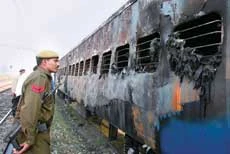
NEW DELHI, 20 February 2007 — Just ahead of a meeting of the “revived” Indo-Pak joint commission here in the capital city, at least 67 people were killed — mainly Pakistani nationals — traveling in a train connecting the two countries. In a suspected case of terrorism, two carriages of the Delhi-Attari train caught fire after explosions at Deewana, near Panipat, about 100 km from New Delhi just before midnight on Sunday.
Police have detained a man in connection with the bombing, Railway Minister Lalu Prasad announced yesterday.
Police had also launched a hunt for his associate, missing since the midnight blasts, the minister said.
“On the basis of information given by eyewitnesses, one person who was present in one of the two carriages that caught fire has been detained,” Lalu said.
He said survivors, including an injured Pakistani national, told him when he visited Panipat that two alleged suspects were sitting in the carriage, “their faces hidden behind mufflers and looking suspicious.”
No group has claimed responsibility for the firebombing. The dead included 26 men, 14 women, 13 children and 14 bodies charred beyond physical recognition.
V.N. Mathur, a senior railway official, who reached the spot from Delhi, said that two suitcases were recovered from the spot — one from the rail track and the other from the train. “It appears to be a case of sabotage. We have found two suitcases, there were IEDs (Improvised Explosive Devices) in them,” Mathur said.
“From this evidence, we deduce that this was a clear case of sabotage,” Mathur said. Later, the police recovered a third suitcase containing two IEDs from another carriage of the train. Bomb disposal experts defused these. Terrorists had planned to blowup more carriages of the train, senior railway officials said.
“The modus operandi is new. They had used low-intensity explosives to trigger the blasts and kerosene to ignite the fire. The idea it seems was to cause large-scale destruction by fire,” J.S. Mahanwal, director of the forensic laboratory in Haryana, said. “We have defused two pipe bombs, two IEDs and recovered 10 to 15 kerosene bottles from three compartments,” Mahanwal said.
President A.P.J. Abdul Kalam expressed “grief over the tragic incident in which a number of people lost their lives,” a presidential palace spokesperson said. Expressing grief and anguish, Prime Minister Manmohan Singh said that culprits would soon be brought to book. Conveying his condolences to the families of the Pakistani victims, Manmohan said steps were being taken “to provide all possible assistance for the injured and bereaved.”
Manmohan received a call from Pakistani Prime Minister Shaukat Aziz regarding the train fire. Condemning the incident, Manmohan declared India’s abhorrence for the “heinous terrorist act” and “reaffirmed” India’s commitment to ensure punishment for criminals.
Pakistani President Gen. Pervez Musharraf expressed his profound grief and shock over the tragic loss of lives.
In a statement issued by the presidency yesterday, Musharraf underscored the need for the leadership of Pakistan and India to move forward undeterred in the quest for dispute-resolution and lasting peace in the region.
He said, “We will not allow elements which want to sabotage the ongoing peace process to succeed in their nefarious designs. Such wanton acts of terrorism will only serve to further strengthen our resolve to attain the mutually desired objective of sustainable peace between the two countries.”
The United States denounced the bombing, calling it an effort to “undermine” peace between the two nations.
“We express our deepest sorrow for this tragedy and extend condolences to the families of the victims,” said White House spokesman David Almacy.
— With input from Azhar Masood in Islamabad, and agencies