TEHRAN, 21 February 2007 — Iran’s elite Revolutionary Guards yesterday staged a war game simulating an enemy airstrike as a second nuclear-powered US aircraft carrier arrived in regional waters in an apparent warning to Tehran.
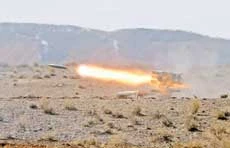
The Revolutionary Guards’ land forces fought back the hypothetical airstrike from enemy helicopters, planes and missiles with 620 anti-aircraft cannon and shoulder missiles, state television said.
“Today, we are fighting back at all kinds of planes at low and average altitudes,” said Brig. Gen. Mohammad Reza Zahedi, the commander of the Guards’ land forces.
“The maneuver is exceptional in terms of the number and types of the weapons used. We have used anti-helicopter weapons with a range of more than 10 kilometers,” he said.
It was the second of the three-day “Power Maneuver” exercises involving 3,000 units of the elite force in 16 of Iran’s 30 provinces, the second war games staged by the Guards this month. Although Washington has always said it wants to solve the standoff over Iran’s controversial nuclear program through diplomacy, it has never ruled out the option of military action against Iran to halt the atomic drive.
The exercises came as aircraft carrier USS John C. Stennis and its accompanying strike group joined the USS Dwight D. Eisenhower in the Sea of Oman yesterday, in a move widely interpreted as a warning to Tehran. The Stennis “entered the US 5th Fleet area of operations ... to conduct maritime security operations in regional waters, as well as to provide support for ground forces operating in Afghanistan and Iraq,” the US Fifth Fleet said from its base in Manama.
“We are ready, we are sustainable, we are flexible and we provide significant capabilities that contribute to regional peace and security,” said the strike group’s commander Rear Adm. Kevin Quinn. The strike group, to which 6,500 sailors and Marines have been assigned, also includes the guided-missile cruiser USS Antietam, guided-missile destroyers USS O’Kane and USS Preble, and fast combat-support ship USNS Bridge.
Tensions between Washington and Tehran over the Iranian nuclear program are spiraling, with Iran set to ignore the latest UN deadline for it to suspend sensitive uranium enrichment activities.
“We are not planning for a war with Iran,” US Defense Secretary Robert Gates said earlier this month when asked about the deployment of the second aircraft carrier group to the region’s waters. “The purpose of that (deployment) is simply to underscore to our friends, as well as to our potential adversaries in the region, that the United States has considered the Arabian Gulf and that whole area and stability in that area to be a vital American national interest,” he said.
The United States accuses Iran of seeking a nuclear weapon, a charge denied by Tehran, which insists its atomic program is solely aimed at generating energy. Washington has also alleged that elements in Iran have smuggled sophisticated bombs into Iraq have killed at least 170 US and allied soldiers since June 2004. Tehran has rejected the allegations as “without foundation.”
The IRNA agency said a total of 750 missiles and cannon munitions would be fired during the exercises, being staged less than two weeks after similar maneuvers by the Guards’ air force and naval units.
Meanwhile, Iran’s Assembly of Experts, the body that selects and can even oust the country’s supreme leader, yesterday began a new nine-year term by voting for its conservative head to stay on in his post. Ayatollah Ali Meshkini retained the presidency of the assembly’s presiding board as the only candidate, the ISNA agency reported.
This Assembly of Experts — the fourth since the revolution in 1979 — was elected in December in polls that saw a strong performance by Akbar Hashemi Rafsanjani against hard-line rivals.
Rafsanjani, Iran’s president from 1989-1997 who won a new political lease of life in the elections, was yesterday appointed the first deputy head of the body.