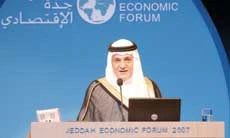
JEDDAH, 26 February 2007 — In a tense debate yesterday at the Jeddah Economic Forum on the issues of security in the Middle East, Prince Turki Al-Faisal accused the United States and its European allies of always avoiding the issue of Israel’s possession of nuclear weapons.
“The Middle East should be free of all weapons of mass destruction. There is unwillingness on the part of America and its European allies to discuss Israel’s weapons. As you have seen just now Gen. Clark and others will go first to Iran, then other countries, and then to Israel,” said Prince Turki to loud applause from the audience.
Prince Turki’s remarks were in response to former US Gen. Wesley Clark’s answer to a question asking what the US should be doing to disarm Israel of nuclear weapons.
During the panel discussion at the end of the session, which also included Baroness Symons of Vernham Dean and Peter Robertson, vice chairman of the board of directors of Chevron Corporation, an attendee asked why Iran isn’t allowed to develop its own nuclear weapons when Israel is known to have a nuclear arsenal.
“We need to open up a security dialogue in this region and we need to bring Iran back — after 30 years — into the dialogue,” said Clark. “We need to stop the slogan of ‘democracy now’, as you can’t implement such things overnight. Eventually that dialogue will move on to include Israel.”
Another question from the audience about the legitimacy of the use of cluster bombs provoked a lively discussion among the panelists about the responsibilities of countries that use such bombs in zones of conflict to tell the affected populations the location of such bombs.
“NATO and Israel should be able to tell people in Serbia and Lebanon where the cluster bombs are,” said Baroness Symons.
A visibly miffed Clark retorted: “I don’t think your comment was mature. I want to go on the record and to be clear that NATO knows where its cluster bombs are and we gave out that information to the Serbs nine years ago.”
Alastair Stewert, the moderator of the session, intervened quickly to end the dispute between the baroness and the general. Gen. Clark surprised the audience when he admitted to have used cluster bombs in Serbia to save the lives of Albanians under siege. “There is a place for the use of force and saving people’s lives,” said the former supreme allied commander of NATO.
Within the context of the theme of the session “Flexicurity in Reform: A Balanced Social Agenda”, Prince Turki emphasized that education is the only way of overcoming ignorance that leads to terrorism and violence.
“It’s fair to say that the basic dragging forces are those who are ignorant. They have closed their minds to what is happening around them in the world. The issue in the Kingdom is definitely this one — you will find men and women from all around the Kingdom who are ignorant. The only way around this is education,” said Prince Turki.
He said that by ignorant people he did not mean illiterate or people who had not gone to university, but closed-minded people who are unwilling to change.
“I am also glad to say that US President George W. Bush is finally moving forward toward peace in the Middle East,” said Prince Turki. “Words like ‘occupation’, meaning Israeli occupation of Palestine, and final-status issues are no longer taboo for the American president and the US secretary of state.”
Prince Turki also mentioned that only 50 Americans are currently studying in the Kingdom compared to the more than 10,000 Saudis studying in the US.
This was in reply to Robertson’s suggestion that more Americans ought to be invited to study in the Kingdom to enhance bilateral relations.
“Rather than more students, we would like to see more congressmen and educators from America visiting Saudi Arabia,” said Prince Turki.