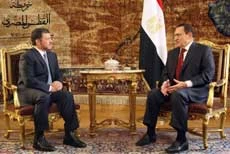
CAIRO, 26 February 2007 — Jordan’s King Abdallah held talks with Egyptian President Hosni Mubarak yesterday on the first leg of a four-nation tour aimed at relaunching Israeli-Palestinian peacemaking.
Their meeting focused on efforts by rival Palestinian factions to form a unity government following a power-sharing deal that has complicated US efforts to kick-start peace talks and so far failed to secure an end to a crippling Western aid boycott.
According to the official MENA news agency, conflicts and crises elsewhere in the Arab world, including Iraq, Lebanon and the Sudanese region of Darfur, were also on the agenda. The tour by the Jordanian monarch coincides with regional visits by Palestinian leaders to build support for their planned new unity government and any future negotiations with Israel.
Today, Palestinian President Mahmoud Abbas will also meet Mubarak, while King Abdallah heads to Saudi Arabia that day, followed by Britain tomorrow and then the United States.
King Abdallah is holding consultations with several Arab leaders before heading to Washington for talks with President George W. Bush and top administration officials, according to Jordan’s official Petra news agency. The king is seeking “a united Arab position to revive the peace process and help both Israelis and Palestinians overcome obstacles hindering their return to the negotiating table,” it added.
On Saturday the Jordanian monarch urged a Palestinian unity government to adhere to conditions laid down by the so-called Quartet of main players in the Middle East peace process.
“It’s not just...the international players, but also the Arab countries are expecting the new Palestinian government to adhere to the policies that we have set out in the Quartet,” the king said in an interview on Israeli television. The Quartet of Russia, the United States, European Union and United Nations suspended aid to the Palestinian government after the election win last year of Hamas, which is regarded as a terrorist group by Israel and the West.
The Quartet has hinged any resumption of aid on the formation of a new government that respects previously signed peace accords, renounces violence and agrees to recognize Israel. The Jordanian monarch also warned in the interview that current efforts to reach an agreement between Israelis and Palestinians mark the “last opportunity” for peace in the Middle East.
“We find ourselves at this very important crossroads, in all our lives, in all our futures, whether it is Israeli, Palestinian, Jordanian or Israeli-Arab.” Jordan and Egypt are the only two Arab countries to have signed peace treaties with Israel, and Amman has played a central role in efforts to broker a peace deal between Israel and the Palestinians in recent years.
The Middle East peace process has been stalled since the start of the Palestinian intifada in 2000, despite the launch in 2003 by the Quartet of a road map for a Palestinian state side by side with Israel.
Jordan, Egypt and Saudi Arabia are also keen on reviving an Arab initiative adopted in 2002, effectively offering Arab recognition of Israel in exchange for the return of territory occupied by the Jewish state since 1967.