
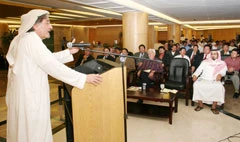
RIYADH, 10 March 2007 — Philippine Ambassador Antonio P. Villamor said yesterday that Saudi businessmen were beginning to realize the investment potential of resource-rich Mindanao in the southern Philippines and welcomed media awareness campaigns to convert such opportunities into business deals. He was speaking on the occasion of the first Mindanao Economic Forum (MEF) organized at the headquarters of Saudi Research and Publishing Co. last night.
A large gathering of Filipino expatriates from Mindanao and Saudi businessmen, including Waleed Al-Swaidan, chairman, Saudi-Philippine Business Council, and prominent Saudi businessmen and investors Abdul Rahman Al-Rajhi, Abdullah Al-Qahtany and Mahdi Mohammed Al-Jaber were among those present. The event was organized by MEF and mainly sponsored by Arab News, with Telemoney (Arab National Bank) and Qatar Airways as the co-sponsors. At the raffle draw held on the occasion, Abdul Karim Disino, Philippine expatriate from Mindanao, won the round-trip ticket to the Philippines. Plaques of appreciation were also handed out to the sponsors and speakers as well as community leaders.
Speaking on the occasion, Villamor welcomed the MEF’s initiative and said it could go a long way in promoting awareness about Mindanao’s business and investment potential. He said a modest beginning had already been made in this direction with the import of bananas from that region, while the possibility of sourcing mangoes, rattan and wooden furniture from there was being explored.
He appealed to OFWs (Overseas Filipino Workers) to contribute their might by purchasing at least SR25 worth of Philippine products as part of their monthly shopping bill. This could translate into imports worth SR300 million annually, given the fact that there were 1.2 million OFWs in the Kingdom. Such a move on the part of the Filipino community could make a dent into the volume of bilateral trade which is heavily tilted in the Kingdom’s favor. Of the total $2.22 billion two-way trade, Philippines’ export to the Kingdom stands at just $39 million, he added.
Speaking on behalf of Arab News, Editor in Chief Khaled Almaeena said Mindanao had good potential in terms of trade and investment opportunities. However, it had an image problem related to security concerns.
“I believe that the problem has to do with public relations. When they think of Mindanao, they think of kidnapping and of Abu Sayyaf,” he said. “This is a minor problem. Let us talk about the good things of the Philippines.”
Almaeena pointed out that even the Kingdom had faced terrorist attacks recently. However, its leadership had risen to the occasion by addressing the challenge. The OFWs, he said, have made a sizable contribution to its economy in spite of the fact that they face problems created by their sponsors, such as nonpayment of salaries and other irritants. He paid tributes to the OFWs without whose valuable support many of the Kingdom’s hospitals would not function. Their services in this regard have been highly appreciated both by the government and the Saudi people.
Almaeena continued: “I believe that the Philippines has a lot to offer. We have a lot to offer. There is the young businessmen’s forum and Saudi Entrepreneurs Forum. Your concerns should be directed to them.”
Earlier, Abdul Hannan Faisal Tago, interim president of the MEF, said the objective of the MEF was to introduce the resources and economic potential of Mindanao to Saudi businessmen who are looking for promising investment schemes. It was also to revive the pioneering role of Arab merchants who had transformed the region into a civilized economic society. The other objective was to bring together Saudi investors and their counterparts from Mindanao and the Philippines in general, he added.
In his presentation on the economic resources and investment potential of Mindanao, Omar Mababaya, senior economist at SABIC, said there was a great potential for the development of agri-industrial projects, since the region was endowed with mineral and agricultural resources.
Mindanao similarly boasts mineral deposits, such as lead, zinc, ore, iron, copper, magnetite and gold. Gold mined in Mindanao accounts for nearly half of the national gold reserves. Its nonmetallic mineral resources include marble, salt, sand, gravel, silica, clay, and limestone.
Together with its strategic location within the East ASEAN region, this key geographic location has a great potential to be a major transshipment point and center of trade in the region.
In a related development, Mindanao Economic Development Co. (MEDCo) said several programs and projects were being carried out to principally address major development initiatives, with a strong focus on areas affected by armed conflicts, particularly the Autonomous Region in Muslim Mindanao (ARMM).
As MEDCo chairman Usec. Virgilio L. Leyretana explained: “There is a strong correlation between poverty and armed struggle occurring in certain areas of Mindanao. This is one of the major considerations for government and donor-assisted interventions.”
Leyretana said a number of these interventions involved communities of former combatants of the Moro National Liberation Front (MNLF), many of whom have replaced arms with farm tools since becoming farmers and small entrepreneurs. He added that assistance was being provided to facilitate socio-economic transformation in conflict areas.
These include livelihood programs, education, health, small- and medium-scale infrastructure projects, energization and capacity-building activities.
In his presentation on the proposed manpower and livelihood-training center, Mohammad Elias Mua, explained how a number of projects could be developed on the basis of the region’s economic resources and market potential. They include a mix of home-based and family-based enterprises, such as food and bakery products, handicrafts, jewelry, fashions, garments, and a number of small-scale industries. The training program required for such ventures varies from five to 20 days consisting of a three-hour program on each day.
He called on the Saudi businessmen to invest in these projects because it would be a win-win situation for both sides. It would help stimulate Mindanao’s economic development. At the same time, it could create job opportunities for Saudis either by employing them in an import agency, if the project was located in Mindanao.
On the subject of Mindanao’s tourism potential, Saidali Malik pointed out that tourist traffic to the region, which had declined by 2.9 percent during 2000-2003 bounced back the following year, when there was an 18.8 percent surge in tourist arrivals. The tourism potential was enormous, especially in the fields of eco and agri tourism.