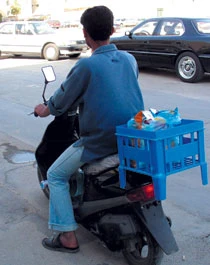
RIYADH, 11 March 2007 — In a relatively new marketing ploy, grocery stores in Saudi Arabia offer free delivery to customers who place their orders on phone. Expatriates, usually from Asia, use mopeds to deliver goods to homes.
Hussain, a Bangladeshi worker employed in a small grocery in Riyadh’s Al-Shefa district, told Arab News that customers come to his grocery shop and set up the free delivery service.
“The customer guides me to his or her house where I stick a special number on his door. The customer usually gives me his or her nickname to be entered on my list. Once the formality has been completed, the customer can place his or her order by phone. I have been holding this job for 10 months, earning SR900 per month. I start at 9 a.m. and continue until midnight. During this period I serve more than 200 customers. We are competing with other groceries on the same street in this neighborhood.”
Hussain points out that his daily chore begins when the cashier in the grocery receives a call from the customer.
“I collect the item, get the customer’s subscriber number and ride my bike quickly to his house to deliver the items. I usually receive cash at the door. I have memorized the locations of houses because I have to pass through the same street many times every day. I know every single detail about this neighborhood. Sometimes I go three times or more to the same customer’s house within an hour. This is because some customers place multiple orders — first bread, then milk, and then water. Some of them even order just a candy for pacifying his or her crying child. This makes me angry, but I have to take it in stride and go, because I don’t want to lose my customers amid all this competition.”
Ali, an Indian working in a big supermarket in Riyadh’s Rawdah district, concurs. He said people are habitually lazy and need every item delivered to their houses.
“Many customers place orders from their cars while returning from work and ask me to bring their order, so I follow them to their houses and deliver goods right inside their kitchen. The problem facing me at this job is waiting for a long time at the customer’s door,” he said. “When I ring the doorbell some customers take time to open the door; sometimes I have to wait 20 minutes for the door to be opened. This causes many problems because other customers are waiting for their delivery.”
“I welcome this new step taken by these shops. Sometimes, I go out with my friends and my family was alone at home, so they can just call the supermarket for home delivery of the order placed on phone,” said Saleh Mohammed.
“It is very dangerous if we don’t educate people, because these workers know every detail about our homes and our family because they come to us every day, sometimes more than once,” said Ibraheem Al-Mesfer. “I think they get more information about citizens.”
Saeed Al-Hasani said that these delivery services have flourished as a result of Saudi laziness. “People should be aware of its consequences,” he said. “This service will create an idle society that depends on others for very simple tasks. It is a symbiotic relationship fostered by the easy-going attitude of society.”
Mosa Kabbash said it is very dangerous to disclose your family details and house secrets to expatriates. “Some of them may be tempted to steal from our houses since they know every single detail about our life — the time when people are inside or outside their houses,” said Kabbash.
However, grocery delivery is not always welcomed by some segments of society. They consider it as a nuisance.