DIYARBAKIR, Turkey, 11 March 2007 — A top Turkish general yesterday reaffirmed Ankara’s right under international law to send troops into northern Iraq to crush Turkish Kurdish rebels hiding there if it saw fit. The comments by Gen. Ilker Basbug, head of Turkey’s land forces, came as Iraqi Prime Minister Nuri Al-Maliki urged all neighboring countries, including Turkey, attending a conference in Baghdad to settle their regional disputes through dialogue.
“Turkey can always take measures against the terrorist organization in northern Iraq if our military needs require it ... under international law,” Basbug told reporters in Diyarbakir, largest city in Turkey’s mainly Kurdish southeast.
His hints at military action were not new but their timing reflects Turkish military fears of an upswing in violence by the outlawed Kurdistan Workers Party (PKK) as spring arrives.
Basbug said he believed up to 3,800 PKK rebels were hiding in northern Iraq, mostly in the mountainous areas bordering Turkey. When the snows melt, many cross into Turkey every year to stage attacks on both military and civilian targets.
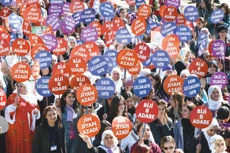
Analysts say a full-blown Turkish invasion of northern Iraq is highly unlikely but do not discount commando raids or airstrikes, especially as politicians feel the need to appear tough on terrorism ahead of this year’s elections. Basbug warned PKK supporters against using the upcoming festival of Newroz, celebrated by Kurds across the region, to whip up violence. Newroz has sometimes led in the past to clashes between security forces and separatist protesters.
Ankara blames the PKK for the deaths of more than 30,000 people since the group launched its armed campaign for an ethnic homeland in southeast Turkey in 1984. Basbug also stressed Turkey’s continued support for Iraq’s territorial and political unity. Ankara fears Iraq’s Kurds want to create their own independent state in northern Iraq, which could in turn fan separatism among its own Kurdish population.
At the Baghdad talks yesterday, Maliki said other countries should not interfere in Iraq’s internal affairs and he urged them to settle any disputes through dialogue.
The one-day Baghdad conference brought together mid-level officials from Iraq’s neighbors, such as Turkey and Iran, Arab countries and permanent UN Security Council members including the United States and Russia.
Meanwhile, Turkey has condemned the decision of a Swiss court to impose a suspended jail sentence and a fine on a Turkish citizen for denying that mass killings of Armenians by Ottoman Turks in 1915 amounted to genocide.
In the first such conviction under Swiss law, the court on Friday sentenced Dogu Perincek, head of the leftist-nationalist Turkish Workers’ Party, to a 90-day suspended jail term and fined him 3,000 Swiss francs ($2,461).
“The court case was inappropriate, groundless and controversial in every sense... The verdict cannot be accepted by the Turkish people,” Turkey’s Foreign Ministry said in a statement released late on Friday. It criticized Swiss media coverage of the case, calling it biased, and said the verdict violated free speech.
Perincek, whose party has no seats in the Ankara parliament, was convicted under a 1995 Swiss law, which bans denying, belittling or justifying any genocide. Twelve Turks were acquitted of similar charges in 2001. Perincek, 65, said he would appeal against the verdict.
Turkey strongly denies claims by Armenia and its supporters that the Ottoman Empire committed a systematic genocide against about 1.5 million Armenians during World War I.
Ankara says that figure is greatly exaggerated. It says large numbers of both Christian Armenians and Muslim Turks died because of inter-ethnic fighting, famine and disease as the Ottoman Empire collapsed.