
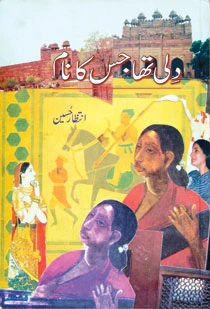
"Dilli Tha Jiska Naam” (Delhi That Was) is a saga of Delhi. Intizar Hussain, one of the most famous Urdu fiction writers, paints the picture of the different dynasties from Pandvas to the Great Mughals who ruled Delhi. His romanticism does not kill the spirit of history. Instead his mastery of fiction makes the book all the more interesting. He is a skillful storyteller who keeps his reader busy with his lucid style and rich imagination. The writer migrated to Pakistan at the time of partition and cherished a sort of nostalgia. When he writes about Delhi, his involvement overwhelms the reader. The love, pains, strong and weak memories of the past make the book a stage on which many characters come and go. Their happinesses and sorrows, their successes and failures make us smile and cry. This is not only a history of kings and emperors but also a picture of ordinary people whose toil and sacrifice support society. This book, like a search light, illuminates the dark corners of Delhi’s society in different ages. It shows the dark places and provides today’s readers with an idea of the lives of kings and paupers in this great city. Like a master painter, Intizar Hussain evokes pictures of ancient, medieval and modern Delhi that enrich our imagination and add to our knowledge. One wonders how a 21st century writer is able to show so exact a picture of bygone days, especially of the common people who have undergone the greatest changes. As Intizar Hussain is well informed and well read, he has successfully come out with treasures which inform and entertain. Much of human history as we know it is the history of kings and emperors. What marks this book is that it is a history of common people. To make this point, Intizar Hussain begins with a great many details of Nizamuddin Aulia and his influence on the life of residents of Delhi in the 1300’s. He turns over a page of his travel diary on his first visit to India after partition. The rainy evening, dark clouds, three dilapidated graves, wild grass and the sound of the peacocks welcome him at the great saint’s mausoleum. This scene speaks volumes. Nizamuddin Aulia’s role in shaping early Muslim India is unforgettable because Muslim society was then at a crossroads. Nizamuddin Aulia was loved and revered by even the Hindu kings who were at war with the Muslim emperors of Delhi. His life and teachings paved the way for social harmony, love and peace among the people. Like his mentor Moinuddin Chishti of Ajmer, Nizamuddin Aulia preached love. He did not discriminate between small and large. Hindus and Muslims alike came in flocks to his small cottage and all found solace. This intentional description of a saint instead of a king or emperor sets the tone of this history. It shows that Islam was not spread by the sword and compulsion but that its message of peace appealed to non-Muslims. Especially today when disinformation and falsehoods are trying to discredit the message of peace, this particular history has considerable relevance. In the remarkable book, Ghauri, Khilji, Tughlaq, Lodhi, Afghans and Mughals have found their proper places but at the same time, the ancient Hindu kings’ contributions to making Delhi a seat of learning and politics are not ignored. Hindu myth, legend, superstitions, hearsay and history are all recorded and given their proper places. We see vivid images of courtiers, poets, scholars, soldiers, traders, artisans, even mendicants and beggars. Every character speaks for its class. Samples of Amir Khusrau’s early Urdu poetry are available and his influence on the minds of the people of his era is evident. In the time of Shah Jehan, Delhi was the center of such pomp and display as it had never seen. In fact Delhi’s importance as a capital of one the world’s richest countries is shown in this history. The Mughal lifestyle and culture dazzle the eyes of readers. Mughal cuisine, fashions, literature, poetry, architecture and their love of India are well preserved in this precious book. We also find a comparative study of Hindu, Islamic and Western civilizations. How these civilizations affected Delhi’s residents is shown in this book. Shah Jehan’s love of Delhi and its residents and his care for them touches one’s heart. After the demise of the last great Mughal, Aurangzeb, Delhi became the victim of internal unrest, looting and foreign invasions. The looting of Indian treasures by Timur, Nadir Shah, Abdali, and Marathas and later by the British resulted in the bankruptcy of the economy and a general decline in the quality of life of the Indian people. The comparative study between Mughal and British is an eye-opener. It shows that Muslim invaders, after a brief stay in India, made the country their home. After conquering it, they sacrificed their lives for its defense and glory. They gave India a unique identity with a large treasury, good administration, powerful army and farsightedness. The British, in contrast, in their later years, never mingled with the local population: They were rulers and Indians the ruled. Particularly in the 19th century, British arrogance and cruelty bred hatred in the hearts of Indians and their so-called reforms were not accepted because the people looked at each move with suspicion. The last looting of Indian treasures left India a pauper. Delhi, once one of the world’s richest capitals, was left a smouldering ruin by the British Army. The last Mughal Emperor Bahadur Shah was cheated, humiliated and later exiled to Rangoon. The Mughal princes who had taken refuge with him in the Humayun’s Tomb after the failed Great Revolution in 1857 and who were promised fair treatment by the British were murdered in cold blood. Delhi’s enormous Jama Masjid, one of the most famous in Islam, was closed down and nobody prayed there for many years. Intizar Hussain’s knowledge of different civilizations, his sense of realism and objectivity make this book worth reading and thinking about. This is due in part to the fact that the new world order which is knocking on many doors on different continents has many of the worst features of British colonial power and rule.