
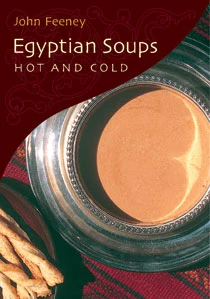
A delightful little book, “Egyptian Soups Hot and Cold,” reminded me of the goodness and the variety of soups. John Feeney, an author known for his documentary films and still photography of Egypt, also enjoys preparing and eating soups.
During his 30 years in Cairo, Feeney pampered his guests with memorable concoctions. How could anyone forget the ambrosial taste of his superlative iced mango soup or his incredible hot cream of guava and ginger soup! Luckily for us Feeney was persuaded to share some of his most original recipes. But I must warn you that this is not an ordinary cookbook. It is a delicious symphony of colors and tastes, a culinary tribute to the soup. This labor of love, illustrated by the author’s own photography, is also replete with exciting facts about the spices, fruits, vegetables and herbs used.
In the section of Hot Soups, we are treated to a sumptuous desert truffle cream soup. With his wonderful sense of humor, Feeney tells us that for this recipe we need “not only a basket of white desert truffles but also a female camel. If a camel isn’t handy, you can use cow’s milk or, even better, light cream.”
White desert truffles, known as ‘fagah’ in Saudi Arabia and ‘kama’ in Syria and Lebanon are considered a delicacy. Bedouins say that thunder and lightning followed by heavy rains cause the spores to germinate. This elusive fungus is not easy to find: it is often a mere lump in the sand. And if its bulbous head ever happens to become exposed, light and air alone will erode its subtle flavor in less than four days.
The rocket or arugula, known in Egypt as ‘gargir‘ is generally eaten as a salad dressed with oil and lemon. Dubbed the Egyptian watercress, gargir makes an excellent soup which Feeney calls a soup of delights because of its aphrodisiac attributes.
The most amazing soup has to be the hot pomegranate soup, an elixir of beef broth, orange and pomegranate juice thickened with yogurt and flavored with thyme, tarragon, mint, bay leaves and cinnamon. The pomegranate, a marvel of nature, is superbly described by the French poet, Andre Gide:
“...Beehive partitioned.
Architecture of pentagons.
The rind splits; out tumble the seeds
In cups of azure some seeds are blood...
Others are drops of gold.
A chilled pomegranate juice with its zippy tang is wonderfully addictive, and I believe its hot counterpart can only be equally seductive!
John Feeney also introduces us to all the goodness of a cream of lettuce soup: “Besides its dream-inducing qualities, lettuce is also a powerful antibiotic. And recent research has shown it has a destructive effect on fatty particles in the blood, known to us as the wicked cholesterol.”
The selection of hot soups includes the classic lentil soup so reviving when the weather is cold. The Upper Egyptians, the Sa’idis, traditionally have a bowl of ‘shorbat ads,‘ lentil soup, for breakfast in winter. Whether one prefers it for breakfast, lunch or dinner, the wholesome lentil soup releases all the goodness, the French chef, De Gouy had in mind when he wrote that soup: “breathes reassurance; it steams consolation; after a weary day it promotes sociability...there is nothing like a bowl of hot soup, its wisp of aromatic steam making the nostrils quiver with anticipation.”
If you are a true soup aficionado, you will always insist on being served a ‘hot’ soup in a bowl and not in those unpractical soup plates which cool it down in no time!
John Feeney also devotes a section to Cold Soups which he describes as “culinary delights.” It is almost worth the trouble of “putting up with the humidity of July and August in Egypt so as to be able to enjoy an iced summer potage,” he says. These cold soups are best served as desserts accompanied by biscuits or a dry cake.
The selection of iced soups begins with one of my favorites — the glorious apricot. Whenever I bite into its golden flesh, my mind drifts along the Karakoram Highway into the Hunza valley, famous for its tiny little apricots. Its inhabitants, known for their exceptional health, have one of the largest numbers of active centenarians. For this recipe, the author insists on using ripe apricots and “never, never“ dried or canned ones. Like many of his cold soups, this one is flavored with fresh ginger. This spice was imported by Cairene merchants from southeast Asia in medieval times and exported to Europe by Venetian and Genoese tradesmen waiting with their boats at Alexandria.
In Egypt, one cannot ignore the mango which reigns supreme during the scorching summer. The idea for this soup came while the author was invited for the inauguration of a hotel in Sidi Abd Al-Rahman on the Mediterranean coast of Egypt. “It was a sweltering July day and the newly installed kitchen had over chilled its fresh mango juice which came out iced and flaky. Their small mistake was my delight and on returning to Cairo I conceived this exotic iced soup.”
The list ends with an Iced carrot and orange soup which can also be served hot during the winter. But I cannot think of a more fitting soup than the iced strawberry soup to end this culinary piece. The author tells us: “On more than one occasion, it has been noted that partaking of this iced strawberry soup provides a relaxed sensation and a general sense of well-being for several hours afterward. It has even been known to arouse in some people a slight sense of joviality, happiness with life.”
This entertaining soup booklet only increased my passion for creative soups. It is an open invitation to try soups which are not only incredibly original but amazingly tasty.