
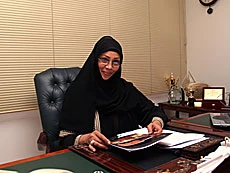
JEDDAH — Behind every successful man there is a woman, and behind the successful Saudi women are their fathers and husbands. The majority of Saudi businesswomen had encouraging parents who pushed them into continuing their studying and then finding their own business interests.
Eiman Ashour Sibie, owner of the Nawara House of Fashion for the past 28 years, is one case study in this regard. “My father, God bless his soul,” she said, adding that her father allowed her to use one of his commercial properties to set up a beauty salon. “Back then there were only two hairdressers (in Jeddah),” she said.
Back then it was no light matter for women to head out on their own to go to the local beauty parlor, which in many societies in the world has been a traditional meeting place for women who often treat a trip to the beauty parlor as a visit to a social club.
According to Ashour, the notion of women going to a commercial establishment — even one that is almost universally a women-only place — and removing their abayas was viewed as a risky venture, a place that could attract unwanted attention from the random passing male stalker. Ashour said in the first years she had to market herself by building trust that her salon was a place of social refuge for women, much like the women-only cafés and shopping malls you find in Saudi Arabia today. It took Ashour six years to break even and longer to earn a considerable profit.
Even today, Ashour says people want to check up on her background and the reputation of her establishment before allowing their womenfolk to enter. (Rumors that some beauty salons have been rigged with hidden cameras for perverted Peeping Toms haven’t helped.)
“I recently got a phone call from a man in Al-Jouf. He told me he’s been asking about my salon’s and my family’s reputation,” she said.
After checking up on her, the man, who was obviously wealthy, sent 35 of his female family members down from Al-Jouf, about 900 km northeast of Jeddah, on a private plane. “People still care about where they are sending their families,” she said.
The Nawara House of Fashion began after Ashour went with her father and brother to the Philippines to personally recruit 28 employees when the business started. Today the business employs 170 people of various nationalities, including Saudis.
“My father made it easy for us at the beginning,” she said. But even with a little help from the family, running a business requires constant vigilance, if anything, to inspire your employees.
“Once the employees see that you are always there, watching over your business and dedicated to your work they will do the same, but once you neglect it, they will do too,” she said.
Ashour says she has been able to build a successful venture through paying close attention to the quality of her staff. She offers bonuses and other incentives. Employees who excel get raises in SR1,000 increments. Long-time workers can get bonuses of around SR10,000, which isn’t bad considering the average Saudi worker earns about SR1,500 a month. After implementing the bonus policy six years ago, Ashour says profits have increased about 20 percent annually. She also sends her employees abroad to learn new techniques in spa services. She pointed out that it’s easier to send her non-Saudi workers to these skills-enhancing events because Saudi families are hung up about the idea of releasing their women for travel.
“Only one or two of my Saudi employees managed to travel, and only because I was with them and their families know me and know my family,” she said. “Other than that it’s only my foreign staff that can benefit from these programs.”
For Saudis, Ashour says she sometimes covers the expense of bringing training to Saudi Arabia. But doing that has its own problems, namely acquiring visas for these foreign trainers.
“I still face difficulties in getting their visas when I get my foreign employees,” she said.
Ashour says that when it comes to help in developing her business, more could be done in Saudi Arabia. She says that she has gotten more help from Dubai’s Gulf Businesswoman’s Committee than from the Jeddah Chamber of Commerce and Industry.
“I failed to get any information from the Jeddah Chamber of Commerce and Industry, but the people in Dubai are really experts and I get the information I request delivered to my door,” she said. “And, I might add, membership is free and the services are excellent. It is a shame we do not have similar services here.”
As far as advice she would offer others, Ashour says it’s very important to plan and to be patient and not rush into projects.
And a little help form the family doesn’t hurt, either!