RIYADH, 27 March 2007 — Saudi Arabia announced here yesterday that it had proposed a special meeting between Sudanese President Omar Bashir and UN Secretary-General Ban Ki-moon to discuss the Darfur issue and the situation in Sudan.
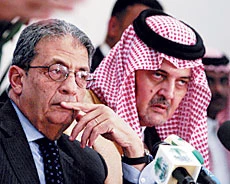
“This special meeting has been called by Custodian of the Two Holy Mosques King Abdullah. The special meeting will be raised in the Arab summit,” Saudi Foreign Minister Prince Saud Al-Faisal said in a press conference yesterday.
The UN wants to create a peacekeeping force in Darfur that would combine international forces with the African Union troops to stabilize the war-ravaged region. Bashir rejects the UN proposal. Hanging in the balance is humanitarian relief and security to what the UN estimates is 2.5 million displaced people, many of whom have spilled over into refugee camps in neighboring Chad.
Prince Saud said that the Darfur crisis would be discussed at length during the Arab summit that starts tomorrow in Riyadh. The minister said that the crisis in Somalia would also be addressed with the aim of coming to some sort of consensus on resolving the conflicts there.
“On the occasion of the UN secretary general’s attendance and that of several representatives of European, Arab, Islamic bodies in the summit, King Abdullah is proposing investing this occasion for gathering all efforts to achieve a national reconciliation in Somalia,” he said. Twenty-one Arab foreign ministers met here yesterday to prepare the final draft for the 19th summit, which will be chaired by King Abdullah. All Arab foreign ministers attended the meeting, except Libya.
According to Arab League Secretary-General Amr Moussa, the meeting resulted in final drafts and recommendations for the summit. He said the summit would discuss three main issues: security in Arab countries, the Arab proposal for resolving the Palestinian-Israeli conflict and social and economic development in the Arab world. Prince Saud said there would be no amendments to the Arab peace proposal to solve the dispute between the Palestinians and Israelis, which includes a withdrawal of Israeli forces to pre-1967 boundaries and a Palestinian state with Jerusalem as its capital.
“Another special report on the development of education in the Arab world would be discussed in the summit,” Moussa said.
Moussa also said that there were proposals to have a separate Arab summit on economic issues alone.
He said the summit would begin with opening addresses and then be followed by a closed-door meeting between kings, presidents, and heads of states of Arab countries.
Moussa also said a report would be discussed at the summit to adopt a unified Arab stance on taking steps to rid the Middle East of weapons of mass destruction, as well as developing civilian nuclear power. A special report on the establishment of a so-called Arab Investment Court will also be discussed. “This has been called for by a large number of Arab investors from the public and private sector,” Moussa said. “It would guarantee the rights of Arab investors, especially after several Arab countries have joined the World Trade Organization (WTO) and the increase of trade flow between Arab countries and other nations.”
Prince Saud said the message that the summit intends to convey is that “the Arab identity is fine. And that our leaders are capable of meeting together with all seriousness and sincerity. There is nothing impossible about Arabs unifying their will together.”
Prince Saud refuted charges that the foreign ministers’ meeting did not produce anything new regarding the Arab stance on Israeli occupation. “Something new has been achieved and that is the unification of the Palestinian stance and the Arab stance,” he said. “They both have agreed on the joint Arab strategy... that has never happened before.”
He said Arab countries were keen on resolving their inner differences and were seeking international support to the unified Arab resolution, which would be produced by the summit.
He said that the Arab peace proposal on the Palestinian issue would be registered at the United Nations, which would be “a basis for peace in the Middle East.”
“Everyone is calling on Arab countries to relaunch the Arab peace proposal,” he said. “There is belief in the international community of its importance, especially since it includes the Jerusalem issue, the return of Palestinian refugees and the 1967 borders.”
The foreign minister said there was no question of Israel being invited to the summit to discuss with Palestinians the proposed Arab peace proposal, saying that was a matter between them and the Palestinians alone.
He denied there were any secret meetings held between Israeli Prime Minister Ehud Olmert and Prince Bandar ibn Sultan, the former US ambassador who now heads Saudi Arabia’s national security apparatus.
“No meeting took place,” he said.
Moussa said that Arab countries “would no longer depend on Western powers for their security,” noting that an Arab peace force to mediate any disputes in the Arab world would be proposed during the summit. “We made this mistake before (summoning Western countries to defend Arab countries),” he stressed.
“These forces would be ready and available whenever they are needed,” Moussa said, referring to the proposed Arab force.
The Arab League secretary-general denied that the Arab summit was an opportunity for Arab leaders to gather and approve a military strike on Iran. “This will not take place. Iran is a Middle Eastern country. We have our differences with it, but the Arab summit would never pass such a thing,” he commented.
Moussa denied that he had met with the intelligence heads of four Arab states after they had met with US Secretary of State Condoleezza Rice in Egypt.
Asked about the fate of Arab journalists languishing in Arab prisons for political reasons, he said the issue was not on the agenda for discussions in the summit.
“The rights of Arab journalists and their protection is a matter that should be brought up with ministries of information in those Arab countries,” he said.