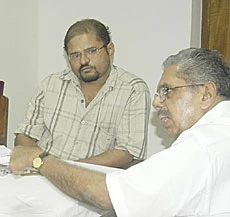
THIRUVANANTHAPURAM, 7 April 2007 — One of the most senior leaders of the Congress party that leads India’s ruling United Progressive Alliance, Overseas Indian Affairs Minister Vayalar Ravi, assumed office only a year ago. Since then, he has been concentrating on one theme — how to improve the lot of Indian workers in the Gulf. The minister believes their problems need immediate attention and, according to him, he has done more than was possible under the strict Indian system.
A trade unionist who founded unions of workers, Ravi has served on important labor-related panels and he believes he has a good understanding of labor problems.
Vayalar Ravi recently spoke to Arab News. Excerpts from the interview:
Q. Do you believe that the lot of Indian workers in the Gulf has improved since Prime Minister Manmohan Singh took over and established a separate ministry for expatriates? What is the biggest achievement of your ministry since you assumed office last year?
A. Issues related to migration to the Gulf and the living conditions of Indian workers there are longstanding and they deserve immediate attention. I have always been with them as their spokesperson and unlike the NRIs in Europe or the US who only need recognition, they need help and assistance. I think we have made a fine beginning by signing protocols with some of the governments there.
There is a steady demand for Indian workers and labor exports are likely to continue for another 20 years. Therefore we are trying to bring in stringent regulations for recruiting agents while ensuring that the regulations not affect the movements of job seekers. Most of them work in the informal sectors and they do not have the protection of labor laws in the host country. A memorandum of understanding was recently signed with the United Arab Emirates (UAE) providing for specific steps to ensure the protection and welfare of Indian workers in all sectors.
Over the next few months, I’m confident that we will conclude and sign similar bilateral labor agreements with Kuwait, Bahrain, Qatar and other GCC countries. As the host to the largest Indian community, Saudi Arabia has top priority. A similar agreement with Malaysia is also being negotiated.
Q. What are the major issues and what steps have you taken to solve them?
A. There are many, such as visa problems, landing in jail after being cheated by fly-by-night recruiters or their own sponsors, nonpayment of salaries and the need for facilities such as proper accommodation — all these issues are present. But there are no trade union rights as such. That’s why I’m giving first priority to the problems of these people. I went to the Gulf countries immediately after taking charge and met the Indian community. The community associations in most of these places, especially in Saudi Arabia, are very strong and they are active in charity. So I instructed my officials to seek their assistance to reach out to the community. The embassies should also understand that associations’ access to the respective communities and the wonderful job they are doing to help out people in distress dramatically reduces the burden on embassies and consulates. There is a proposal to appoint a community consul at all embassies and diplomatic missions in the Gulf. Appointment of one consul has already been approved and two more are almost cleared. I will meet Finance Minister P. Chidambaram soon to finalize the others.
I advise all job seekers to keep a copy of their passports at home so that the Indian authorities can bail them out in case they are cheated by their sponsors or recruiting agents and end up in jail. Many of them are in jail without proper documents to prove their identity.
Q. Could you elaborate on the labor pact?
A. The proposal actually came from the other side, both from the respective authorities and community bodies. The first encouragement came from Bahrain’s Crown Prince Shaikh Salman Bin Hamad Al Khalifa and then the UAE Labor Minister Ali Bin Abdullah Al-Kaabi. It was quite encouraging and I was convinced that I could do something for the laborers.
The main feature of the MoUs signed with the UAE is that the sponsors or contractors are liable to fulfill whatever they agreed to in the contract without any delay during the term of the contract, whether it’s two or three years. You can’t deny the workers their wages, their right to proper accommodation, medical benefits or whatever was agreed to in the contract.
There is a six-member joint committee, three from us and three from the UAE government, to monitor if the agreement is functioning properly. The committee will meet at least once in every six months in New Delhi and Abu Dhabi alternatively.
Housemaids and unorganized agricultural workers are not covered by the existing labor laws but once the new agreement is securely in place, they will also get protection, like any other worker. It’s a big achievement.
The UAE labor minister has informed me that the UAE will soon provide the workers with a smart card containing all personal details including the passport and visa information. I have also sent draft MoUs to all other GCC countries for their consideration and suggestions. I’m going to Kuwait on April 8 and from there to Doha on April 14 to finalize them. I hope to sign similar pacts soon with Oman, Saudi Arabia and Bahrain.
A major problem that we have is people going to the Gulf on visit visas and then taking jobs there.
Last year, 550,000 workers went out with the knowledge of the Protector of Emigrants (PoE) under my ministry. But 420,000 people went out on visit visas without PoE clearance. This is developing into a real issue for us. Once these people land there, without proper papers, the labor supply rackets enslave them.
Q. What are other initiatives of your ministry?
A. I have sanctioned 10 million rupees to the Kerala government to set up pre-departure training centers for job seekers and I hope the Non-Resident Keralites Affairs (NORKA) department (which is under the direct control of Chief Minister V.S. Achuthanandan) will do something to implement it.
I have also given money to Tamil Nadu, Andhra Pradesh, Karnataka and Maharashtra states that are making efforts to improve the quality of manpower exports.
A major initiative this year will be the “Pravasi University” run by NRIs and it will be a reality within six months. The single-campus project needs 1,000 acres of land and it will go to that state that is first to offer the land.
Q. Will it be in Kerala?
A. I’m personally in favor of the university coming to Kerala since the state’s economy is heavily dependent on overseas remittances. It would help create more professionals and thus more foreign exchange earnings. Now we are working on the details. There is an academic council to select courses and disciplines and an evaluation committee will monitor the whole process. The university will offer courses in engineering and health sciences up to international standards and several eminent NRI professors have expressed their willingness to join the university.
Q. What is the status of your proposal to amend the Representation of People Act 1851 for enfranchising NRIs?
A. The bill to allow voting rights to NRIs was cleared by the standing committee of Parliament and the Law Ministry. I hope to pilot the bill in the next session of Parliament. All Indian passport holders will be able to cast their votes if they are present in India during elections. We have no plans to allow absentee voting or overseas voting counters. We have already started issuing the Overseas Citizenship of India (OCI) cards to People of Indian Origin (PIO) which grants them all citizenship rights, except that of voting.
Q. Many workers face a bleak future without much savings and resources to sustain their families once they return for good. Do you have any plans for them?
A. I have proposed a one-billion-rupee welfare fund to help expatriate workers in distress and those who plan to settle down at home. Talks are in advanced stages and the finance department has in principle cleared the project which will be on public-private participation (PPP) model. We will provide a corpus and it will be similar to the Provident Fund. They can put money in the market and make money out of it. You will get money either for a pension scheme, rehabilitation and housing, on death or whatever. I have already spoken to the insurance companies and they have agreed to cooperate.
Q. There have recently been several cases of housemaids being forced into prostitution in Dubai. Is there any proposal before your government to prevent this?
A. We are formulating some strict and detailed rules such as routine reporting at the embassies. We want to know who are recruiting these women and who are employing them. We will check their credibility and everything will be recorded and tracked on computers. We are going to make these people responsible for the safety of the women they take to the Gulf.