NATANZ, Iran, 10 April 2007 — Iran announced yesterday it had begun industrial-scale nuclear fuel production in a fresh snub to the UN Security Council, which has imposed two rounds of sanctions on it for refusing to halt such work.
The announcement marks a shift from experimental atomic fuel work involving a few hundred centrifuges used for enriching uranium to a process that will involve thousands of machines.
Western nations fear this will bring Tehran closer to what they say is its aim of building atomic bombs. Iran insists it only wants the fuel for generating electricity so it can export more of its oil and gas.
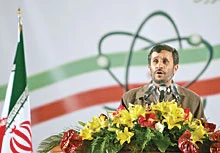
“I proudly announce that as of today Iran is among the countries which produce nuclear fuel on an industrial scale,” President Mahmoud Ahmadinejad told a gathering at the Natanz uranium enrichment facility in central Iran.
Washington swiftly denounced the declaration, saying it proves that UN sanctions against Tehran were justified. “It points to the idea that the actions that we are taking in concert with members of the Security Council are the right ones to take, that they’re legitimate based on Iran’s behavior,” State Department spokesman Sean McCormack said.
Iran, which announced a year ago it had produced its first tiny batch of enriched uranium, had said it would install 3,000 centrifuges as a first stage toward “industrial-scale” output.
Chief nuclear negotiator Ali Larijani was quoted by Mehr news agency as saying Iran had “reached the capacity of 3,000.” Asked if feedstock uranium gas had been injected into them, he told reporters: “Yes, we have injected gas.” Diplomats previously said Iran had set up a third of the 3,000 machines but had not introduced feedstock. An Iranian official told ISNA news agency that UN inspectors who routinely visit the country’s nuclear installations would confirm centrifuge numbers in 20 days’ time.
Analysts say Iran has used such announcements of atomic progress in the past to strengthen its bargaining position with the West, but that such statements have often glossed over technical glitches they say have plagued Iran’s nuclear work.
Iran aims to build 54,000 centrifuges, which spin at high speeds to produce fuel for power plants or, if it is enriched further, bombs. With 3,000, Iran can make enough material for a bomb in one year if it wants to, Western experts say.
Ahmadinejad said Iran would not bow to pressure to stop its atomic work, which he insisted was a right under the nuclear Nonproliferation Treaty (NPT). The West says Iran must prove its program has no military aims to enjoy that right.
“Iran has so far moved on a completely peaceful path and wants to continue following this path. They (the West) should avoid doing something which forces this nation to review its behavior,” Ahmadinejad said.
The UN Security Council has passed two sanctions resolutions on Iran since December, targeting its nuclear and military sectors and severely impeding its financial transactions with the outside world. “If they continue to pressure Iran over its peaceful nuclear activities we have no other choice but to review our membership of the NPT,” said Larijani.
Western diplomats say quitting the NPT would undermine Iran’s case that its goals are civilian. Iran has made similar threats before without acting.
Iranian state television reported yesterday that a Revolutionary Guard general whose travel was restricted by the UN Security Council has visited Russia without any difficulty.
Gen. Mohammad Baqer Zolqadr, who is also deputy interior minister for security affairs, was one of 15 Iranians listed in Resolution 1747 that the Security Council approved unanimously on March 24 to punish Iran for failing to stop enrichment of uranium. Zolqadr was quoted as saying that his six-day journey to Moscow showed “the ineffectiveness of the resolution.”