
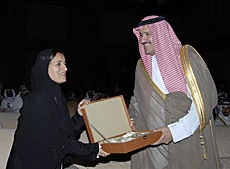
RIYADH, 15 May 2007 — Officials, who had gathered at the Saudi-UAE Economic Forum, agreed that urgent measures were needed to solve economic obstacles between the Kingdom and the UAE, and that small differences between Saudi and Emirati businessmen should not be allowed to hamper further progress in joint ventures between the two countries.
In the conclusion of the two-day conference, which was organized by Asharq Al-Awsat, a sister publication of Arab News, several officials — including the UAE Minister of Economy Sheikha Lubna Al-Qasimi, Saudi Research and Marketing Group (SRMG) Chairman Prince Faisal ibn Salman, and President of the Saudi Chambers of Commerce and Industry Abdul Rahman Al-Rashed — attended the final session of the conference.
The forum also saw a series of Saudi and Emirati government officials address a number of serious issues, which stand in the way of joint ventures between the two countries. In the workshops, officials discussed topics such as dumping, custom tariffs, trade volume and the need for committees to enhance banking cooperation, as well as the need for further collaboration between Saudi and Emirati businesswomen in the real estate sector.
Another matter they raised was the need to address the differences in rules and regulations between the Kingdom and the UAE. Officials suggested that the best way to enhance joint ventures was to begin with small and medium joint initiatives.
A healthy debate occurred between Saudi and Emirati businessmen in the final session, which was centered on the establishment of balanced investments in light of the different investment regulations that exist in both countries.
Awad Al-Awad, an official from the Saudi General Investment Authority (SAGIA), said that government authorities should address the obstacles between the two countries within a specific timeframe. He also blamed private institutions in both countries for not defending their rights in the difficulties that face them.
Abdul Rahman Al-Zamil, chairman of the Al-Zamil Company, blamed both the Saudi and Emirati sides for not progressing in joint ventures due to existing problems in economic trade between the two countries. “Are both governments capable of facing the challenges of reality?” Al-Zamil asked.
Saudi businessmen mentioned that small problems, which exist in both countries in relation to their attitude toward foreign investors, have put both countries in the bottom of the list of best countries for investment. However, he expressed optimism, adding that by 2010 the Saudi General Investment Authority (SAGIA) was keen on putting the Kingdom in the top 10th position of the list of best investment countries.
Abdullah Al-Humoudi, Saudi deputy minister for foreign trade, said the “opportunity was reap” for investment between the two countries, and added that that the Supreme Council of the GCC had legislated laws and regulations in the areas of real estate and commercial advertisements.
He specifically said that rumors were one of the main difficulties faced by investors in both countries.
According to the official, trade volume between the Kingdom and the UAE jumped from SR500 million in 1981 to SR24 billion this year.
Another speaker, Abdullah Al-Saleh, the Emirati deputy minister of economy, said that every emirate in the UAE had its own rules and regulations, a matter that should be understood by Saudi investors. “Every emirate has its own economic regulations as well as industrial laws,” he said, adding that negligence from the part of GCC investors to understand the laws of each country was another obstacle.
“The investor sometimes is not aware of the national treaty regulations, which could speed up his paperwork,” he said, stressing that Saudi investors should learn about UAE regulations before deciding to invest there.
He added that Emirati businessmen were not provided with privileges in the export of Emirati products to the Kingdom. He further hoped that more economic deals would be signed between the two countries to end the problem. “Economic obstacles should be eliminated between the two countries very quickly,” he said.
Regarding the investments of Saudi businesswomen in the UAE or the investments of Emirati women in the Kingdom, Al-Saleh said that this problem was currently being addressed in the chambers of commerce and industry.
“We have good experiences with Saudi businesswomen from the chambers of commerce in Dammam. We hope that relationship would expand to include other chambers,” he said.
Salah Al-Shimasi, chairman of a local Emirati company, said that investors in both countries should illustrate “good intentions” for the sake of establishing joint ventures. He added that there were communications between Saudi and UAE officials to ease investments between the two countries.
“I hope that the small investor is given the right information to enable him to adjust to the real challenges instead of being surprised at the difficulties in the trade exchange later on,” he said. He also mentioned that despite the challenges, Saudi-UAE joint ventures were the largest in the GCC and the Arab region in terms of volume.
He added that the majority of differences between the UAE and Saudi companies were “individual cases” and should not be generalized.