
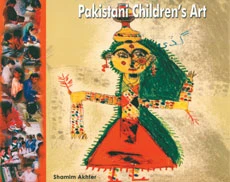
Ms. Shamim Akhter is a journalist by profession. But instead of professing the might of the pen, she prefers to highlight the brushstrokes that paint a child’s vision on a canvas. Her love of art is inherent and she gave it life by promoting children’s art in her country. While working as editor of a popular women’s magazine “Akhbare Khawateen,” she wrote many articles about Pakistani artists. And her incisive knowledge and passionate paean for the canvas over the past two decades has resulted in her considerable fame as an art critic. The Mag publishes her column about art. She has immense interest in children’s art and in order to promote it, she compiled this valuable book. “Pakistani Children’s Art — A Documentation” has been well received in art circles. Akhter found no reference of Pakistani children’s art in her country but instead of complaining, she decided to do something herself. This beautiful book is testimony to her labor, rich taste, refinement, broad cultural outlook and her love for children and Pakistan as well as the world’s heritage. She documented children’s painting from all parts of Pakistan without consideration of cultural, economic, rural or urban backgrounds. She accepted children’s paintings as a gift from God to mankind.
She says, “Our world is all form, color, rhythm and logic...Children never lose any opportunity to express themselves through line and color and will shape any plastic material that they can lay their hands on.” She makes a powerful observation when she says, “Painting competitions among schoolchildren in Pakistan reveal that art comes from within children belonging to less fortunate families. Works displayed at commercial art galleries by children from the affluent class were found less imaginative and the result of less effort and sense of composition than the works of the less fortunate who participated in painting and poster competitions organized by the Japan Cultural Center in Karachi, Unilever Pakistan and Colgate Pakistan. Children at these competitions showed more effort and better sensibility.”
She has different age groups of children for her observation. Children at an early age have sharp eyes with a sense of keen observation and a vivid imagination. Their pictures reflect these qualities. They often like to paint a landscape with a river running beside a mountain range. If a child believes in straight lines, then the mountains take a triangular shape. The children from 9 to 13 show a knack for schematized forms; they show the growth of their perception by painting houses, animals, celestial bodies, trees and vehicles. Children at age 14 and more are inclined to imitate the techniques of adult artists.
Akhter believes that art cannot be taught in the same way as alphabets and numbers. So before the children are taught art they should be allowed to paint on their own because it means freedom for them. Akhter, in this collection, has tried to introduce samples of paintings from all the provinces of Pakistan. The paintings depict almost all the important historical buildings and monuments of the country. Her selection of children’s paintings, which were showcased at the Karachi Arts Council on May 10, 2000, is amazing. Children from 23 countries, including Bangladesh, Bulgaria, China, Egypt, India, Italy, Japan, Malaysia, Norway, Qatar, Russia, Slovakia, South Africa and Turkey participated in the exhibition.
Mariam’s Special World 2002, which showcases 50 abstract paintings by Mariam, an 11-year-old girl, defines the psyche and genius of special children. It is striking to note that a child suffering from Down’s syndrome can produce paintings of such sensibility. Mariam, who was born with speech and hearing retardation, is able to communicate her feelings through her paintings. The credit goes to her parents who detected and discovered their daughter’s genius.
This book has many newspaper clippings too that contain paintings by children. These clippings show a play of children’s imagination and their dream world. Akhter says, “The grand purpose of all teaching is to cultivate a correct vision,” and this book reflects her love for children and her keenness cultivating their visions.