
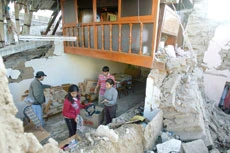
CHINCHA, Peru, 17 August 2007 — Powerful aftershocks shook Peru yesterday as rescuers pulled wounded and dead from collapsed homes and churches a day after a massive earthquake killed hundreds of people.
Hospitals were overwhelmed with injured in the cities of Chincha and Pisco on the Pacific coast, and bodies were gathered on street corners in Pisco.
Peru’s firefighting agency said at least 500 people perished and 1,600 were injured in the 7.9-magnitude quake and the death toll was expected to rise.
The US Geological Survey reported aftershocks of magnitude 6.0 and 6.3 yesterday morning near the central Peru coast.
Wounded people lay on the floor in the San Jose hospital in Chincha, south of the capital Lima. Television images showed walls in the hospital destroyed by the quake. “A wall fell on her. There are no beds and they can’t give her a bed until they can X-ray her, but there’s no power,” Hernando Rodriguez told a television reporter as he sat with his daughter in the hospital, hoping she could be moved to Lima.
In the San Juan de Dios hospital in Pisco, Dr. Ricardo Cabrera said staff was struggling to cope with 200 wounded and more than 40 dead, with no power and a large part of the hospital damaged.
He said there was no morgue in the city and bodies were being gathered in the main square and on street corners. “There are a lot of bodies still in the rubble,” Cabrera told RPP radio, calling for blood, bandages and medicines.
Many people were forced to sleep outside in cities devastated by the huge tremor, which cracked highways and cut power and telephone lines.
“The first impression of the team is that damage is severe, especially to houses,” said Giorgio Ferrario, the South America representative for the International Federation of the Red Cross and Red Crescent Societies.
“The toll has jumped to between 500 and 510 dead and 1,600 injured,” the head of the country’s firefighter service, Roberto Ocno said by telephone from the affected zone. “There are dead trapped under houses,” he said. “There are several bodies in the streets, people who may have died from heart attacks.”
The government said it was launching an airlift with helicopters and planes to bring emergency aid to the hard-hit coastal towns, cut off by the quake.
“I was with my children when the movement started and then the walls collapsed. My house was destroyed,” Milagros Meneses, 35, told Reuters in the city of Canete, south of Lima, where at least two people were killed. “The hospital gave me a tent for my kids to sleep in.”
In the poor Canete neighborhood of Imperial, people set fires inside the ruins of their homes to keep warm during the night. “The situation is critical in Imperial. About 80 percent of the adobe houses have fallen and houses of stronger material have also collapsed,” Mayor Richard Yactayo said.
President Alan Garcia sent condolences to the families of the quake’s victims and said the country had narrowly escaped even greater disaster. “It fortunately did not cause a catastrophe with an immense number of victims,” he said.
In 1970, one of the world’s deadliest earthquakes killed an estimated 50,000 Peruvians in catastrophic avalanches of ice and mud that buried the town of Yungay.

