
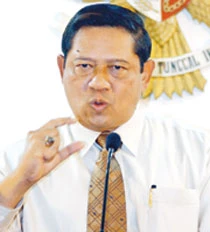
Under the leadership of the President of the Republic of Indonesia H.E. Dr. H. Susilo Bambang Yudhoyono, Indonesia continues to thrive into a steady progress. Indonesia has now become the world’s third largest democracy, after India and the United States.
Moreover, Indonesia is a living proof that Islam, democracy and modernity can live and thrive together.Indonesia has restored civil and human rights, reformed the military, overhauled its political institutions and amended its Constitution so that Indonesian people now have a voice in political decision-making.Indonesia has finally resolved conflict in Aceh after three decades of bloodshed. In other places where unrest once took place,
Indonesia is addressing grievances through legal action, dialogue and reconciliationIndonesia is waging a vigorous campaign for good governance and a relentless battle against corruption.Indonesia has achieved a great deal of decentralization. Local authorities in Indonesia now have all the powers and resources, and they are also directly accountable to their constituents, who now elect them to office.
There is also an ongoing exercise to eliminate local level regulations which are inconsistent with central government policies and standards. For instance, there is now a positive list of what local governments are allowed to tax, everything else is not allowed.On the economic front, Indonesia has revamped its financial institutions and pursued prudent fiscal policies.
And it has succeeded in maintaining macro-economic stability, as well as ensuring that it has the elements for sustained growth.Growth has been increasing steadily to 5.6 percent in 2005 and 2006, the highest since the crisis. Indonesia expects to achieve 6.3 percent growth or higher this year. In the last three quarters our growth is 6%.
This growth is driven mainly by the recovery of private consumption and investment as well as continued export growth. The revival in consumption is evident in the sales growth of a number of goods such as motorcycle, automotive, electronics, other consumer products, and construction materials.
The investment picture is getting brighter. In the first six months of 2007, approved domestic investments increased from $7 billion to $12 billion and approved foreign direct investment tripled from $6 billion to $24 billion, compared to the first six months of 2006.Indonesia exports are also doing well. They crossed the $100 billion threshold last year.With strong export growth and capital inflows both for direct investment and for portfolio investments, Indonesia’s international reserves exceeded $50 billion — another first in our history.
Inflation has come down since the effects of the domestic fuel price increase last year, and up to June of this year. Inflation year on year is 5.77 percent, so that interest rates have been steadily coming down, which has also stimulated credit and investment growth. The rupiah also remains stable.On the fiscal side, Indonesia budget deficit was 1.1 percent, well below the OECD standard of three percent and its Debt to GDP Ratio stands at 41 percent, the lowest since the crisis. Indonesia has also settled its debt with the IMF four years ahead of schedule.
Indonesia’s credit rating, as assessed by Moody’s, Standard and Poor’s, and Fitch, is now at its highest since the crisis. The Jakarta Stock Exchange showed the third fastest growth in the world at the end of 2006, after Russia and China. The Jakarta Composite Index continues to soar, recently passing the 2,400 mark.
The World Economic Forum ranks Indonesia 50th in its 2006 global competitiveness index ranking, a significant rise from 68th position the previous year.One of the key priorities to achieve sustainable growth is of course infrastructure. Here, the Indonesian government has identified the key areas for infrastructure development including 1,600 kilometers of toll-roads, power plants and ports. The value of investments amount to $146 billion.
The government has created the framework and regulations to encourage public private partnerships in the building of our national infrastructure.Indonesia is also sustaining a reform program to ensure a conductive climate for investment: A climate of legal certainty, policy consistency and reduction in the cost of doing business in Indonesia.
The new investment law we enacted last April will help create that climate. Under this law, there is equal treatment for domestic and foreign investors, greater legal certainty and transparency, streamlining of the investment process and a number of incentives in the fiscal, land and immigration areas.
There is also already a customs reform package in place, and the revised tax reforms are currently being discussed in parliament. We are also continuing to improve the implementation of the labor regulations and safeguarding a good process of industrial relations.