
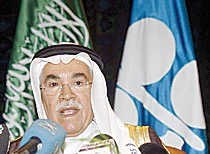
RIYADH, 14 November 2007 — Minister of Petroleum and Mineral Resources Ali Al-Naimi said here yesterday that the third OPEC summit scheduled for Saturday and Sunday would not discuss any increase in oil output or anything related to such matters.
Addressing a news conference, the minister said that the summit would focus on three points: efficiency, prosperity and protection of the oil industry.
The Kingdom, he said, plans to increase oil production in the next two months from 11.5 million bpd to 12 million bpd by pumping an additional 500,000 bpd of light crude oil as part of the country’s commitment to boost output for the global oil market. He pointed out that the Kingdom and other OPEC countries had been recognized for their efficiency, discipline and commitment to the market.
Asked about the reference to prosperity, the minister said OPEC was committed to safeguard the interests of both oil producing and importing countries. Al-Naimi also stressed that the group was closely following any signs that would cause a rise in oil prices, whether it was in terms of demand or the growth of the global economy. “OPEC does not wish to see any country stagnating when the price of oil is rising in the global market.”
Oil prices have reached a new high of nearly $100 a barrel. OPEC officials denied last week that the organization was to blame for the rise which is the result of a number of factors.
The oil minister reassured importing countries that OPEC member states were capable of handling any future turbulence in the market.
Al-Naimi said: “The region always witnesses turbulence and problems but despite those, we have a firm commitment to the global market. I believe that the unjustified skepticism is intended to manipulate prices which Saudi Arabia and OPEC countries are seeking to stabilize.”
He said his response to dubious studies and opinions were to illustrate the Kingdom’s — and OPEC’s — commitment to respond quickly to any turbulence in the market. He also said that oil prices were determined by the market and that several extraneous factors had contributed to the price surge over which OPEC had no control. “It is difficult to determine future pricing,” he admitted.
The Kingdom, he explained, was continuing to look for opportunities through which it could benefit from petroleum and refinery industries outside its borders. He also said that the Kingdom was seeking to expand its market in the world in order to increase its refining capacity to some two million bpd of crude oil.
Regarding environmental aspects of the industry, Al-Naimi said that the Kingdom and Saudi Aramco participated in all conferences related to environmental protection. “The Kingdom is a signatory to several international agreements, including the Kyoto Protocol.”
He also expressed Riyadh’s concerns over climate change. Regarding the intent of some European agencies to sue OPEC, Al-Naimi said: “Any country has the right to file a lawsuit. And OPEC has the ability to respond.”
He dismissed concerns that non-fossil fuels would replace oil as a primary source of energy in the future.
Meanwhile, oil prices fell 4.5 percent yesterday after the International Energy Agency cut its forecast for world oil demand growth, saying that the recent surge in oil prices had already hurt consumption.
US light crude for December delivery shed $4.2 to $90.42 a barrel by 1845 GMT, while London Brent crude fell $3.88 to $88.10 a barrel.