
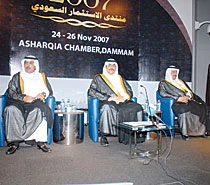
DAMMAM, 25 November 2007 — Saudi Arabia is No. 1 in the Middle East region in attracting foreign investment, Eastern Province Gov. Prince Muhammad ibn Fahd said here yesterday after opening the Saudi Investment Forum 2007 and an exhibition that is being held on the sidelines of the forum.
Speaking to reporters, the governor emphasized the need for new investment projects to focus on all industries, especially the larger ones.
“Eastern Province is an attractive place for tourism and industry due to many reasons, most importantly the availability of real estate for good prices compared to other countries in the region,” he said.
Prince Muhammad said the region needed more hotels and furnished apartments in order to meet the requirements of the increasing number of tourists. He highlighted the Kingdom’s remarkable economic progress and said the current economic boom covered all sectors.
A three-day high-profile strategic Saudi Investment Forum (SIF2007) began here yesterday with a first-day focus on huge investment opportunities in the Kingdom’s multibillion-riyal telecommunications industry.
“The telecom sector plays an important role for investment in Saudi Arabia as new licenses mark a key milestone of growth in this sector,” Asharqia Chamber President Abdul Rahman Al-Rashed.
The forum, he said, provides a unique opportunity for senior government officials and leading international players to discuss the economic drivers and the supreme investment opportunities in the Kingdom.
In attendance for the first day’s lively sessions were key figures from the telecom industry. They included: Mobily CEO Khalid Al-Kaf; Zain CEO Marwan Al-Ahmadi; KPMG’s head of telecommunication practice, Slim Saidi; Communication and Information Technology Commission (CITC) Gov. Abdul Rahman Ahmed Al-Jafary; Deputy Gov. Abdul Rahman A. Al-Fehaid; Awalnet President Fahd Al-Hussain and Saudi Integrated Telecom Company Vice President Waleed Mohammed Al-Abdulsalam.
According to businessmen attending the forum, Saudi Arabia’s mega projects require an enormous and unprecedented level of investment over the next 15 years.
Al-Rashed said the forum was not only geared toward identifying specific projects, “but also provides a platform for discussion on how the Kingdom’s infrastructure and transportation network can keep up with growth in demand in the coming years.”
Al-Rashed pointed to the increasing confidence of the world’s top ratings agencies in the Saudi economy.
“Now is the time for foreign investors to participate in Kingdom’s booming economy in a big way,” he said.
Asharqia Chamber Secretary-General, Adnan A. Al-Nueim said: “We have provided a platform to experts, visionaries, strategists and decision-makers from government and private sectors to discuss and identify challenges and investment opportunities in the Kingdom’s major sectors such as construction, telecom, IT, real estate, transportation and tourism.”
Mobily CEO Al-Kaf impressed the delegates with his keynote presentation that dealt with on how to balance the existing 2G network infrastructure investment with the push toward 3G and wireless, broadband and Voice over Internet Protocol (VoIP) technologies.
Saidi of KPMG wowed the delegates with his prescription for what is in store for mobile operators in the region.
“The sky is the limit,” he said. “The opportunities are phenomenal.”
A lot of young Saudi business executives were keenly taking notes and raising important questions during the question-and-answer sessions.
Mohammad Al-Rasheed, deputy general manager of Al-Babtain Le Blanc Telecom Systems Ltd., said the forum was good, “but we are looking for specific projects to invest in.”
Al-Rasheed added that nobody seems interested in promoting venture capital.
“We in Saudi Arabia are still sticking to the traditional mode of business,” he said. “Here when people invest in something they want to control that investment. That is not how things work. It is important for businesspeople to identify key people, invest in them and forget about controlling the investment. That doesn’t help. That kills creativity.”
The other way of Saudi investment is to look only to the top businessman.
“If a rich businessman invests in a certain company, everyone rushes in there thinking that the judgment of that big businessman will be certainly right,” he said. “(But) that big businessman is taking a risk and he can absorb the losses unlike others. We have to get out of this cycle.”
He said one good aspect of the stock market was that people have started looking into the background of the companies before putting their money in, a process called “due diligence”.
Gyan Prakash Agarwal, Al-Suwaidi Group’s chief business development officer, said the conference was very important for him and his group.
“We want to know in which direction are the country’s industries heading,” he said. “What are the key indicators? Which areas we as a group should concentrate on? Where are the growth prospects? Where can we invest next?” Al-Suwaidi Group employs nearly 15,000 people from 30 countries.
Agarwal said Saudi Arabia and the region have huge growth potential. “The country has a very young population,” he said. “These youngsters are into all kinds of new technologies. That is indication enough of where we should head next.”
Ghurmallah A. Al-Ghamdi of Saudi Aramco said he had a unique reason for attending the conference.
“I will soon retire and I now regret that I had not taken the investment route earlier,” he said. “One should have his own business. This conference will give me an idea of what areas I can look into. Plus, this is a huge opportunity to network.”
There was a substantial presence of women too at the conference, but they were seated in a separate hall. The forum also incorporates an international exhibition that allowed companies the opportunity to present their knowledge and technical innovations in their area of expertise.
— Additional input from Faiz Al-Mazrouei